Vilnius University Perovskite Laser Structure Runs Stably for More Than 400 Million Pulses
Perovskite laser maintains stable performance over 400 million pulses
Topics and contents
A perovskite laser structure demonstrated by a Vilnius University research team maintained stable performance after more than 400 million pulses. The team prepared a material in which part of the lead is replaced by zinc using spin coating in a nitrogen atmosphere, analyzed its properties with confocal luminescence measurements, and then formed a DFB grating by interference laser ablation. The research was published in Advanced Optical Materials, and the samples combine good stability with narrow emission lines.
By linking material preparation, confocal luminescence measurements and grating fabrication, this study offers a concrete experimental path for understanding the stability of perovskite laser structures.
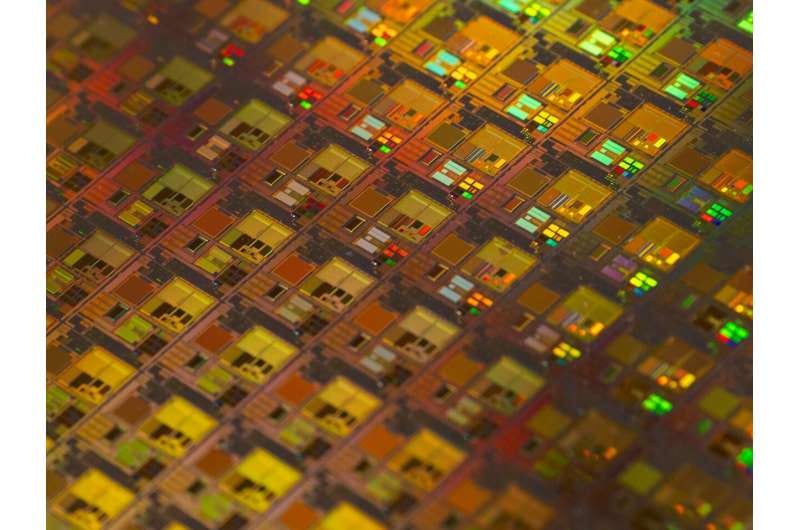
In a study published in Advanced Optical Materials, researchers at Vilnius University (VU) demonstrated perovskite-based laser structures that maintained stable performance over more than 400 million pulses. Their findings address one of the major challenges limiting the practical use of perovskites: their instability. These semiconductor materials could play an important role in next-generation optical technologies, but their tendency to degrade has long posed a challenge for researchers worldwide.
A promising material
In some sense, perovskites can be compared to graphene. Like perovskites, graphene spent years being studied in labs because of its potential before industry eventually began using it. Today, it's widely applied in solar energy, electronics and batteries. Perovskites may hold even greater potential, but they come with a major drawback: they're highly unstable and degrade quickly in the presence of moisture.
Scientists are putting effort into figuring out how to overcome these hurdles and unlock perovskites' potential. Among these researchers are Vilnius University doctoral student and junior researcher Abdul Mannan Majeed and Dr. Patrik Ščajev.
"Perovskites are popular right now because they're easy to produce using casting methods. Quite a few papers have already been published on the topic, including in some very good journals. We decided to make our own perovskites using the same spin-casting method in a nitrogen atmosphere, but with reduced lead content, replacing part of the lead with zinc," says Ščajev.
A complex and meticulous process
Once the samples were made, they needed to be properly tested, which is where Ščajev turned to a colleague, Dr. Augustas Vaitkevičius. Vaitkevičius runs experiments using high-resolution confocal microscopy, a technique that uses light to observe how perovskites emit radiation back.
"This emitted light depends first and foremost on the material's chemical properties and composition. It's a way to measure how the environment affects perovskites. Through these tests, we can better understand where and when degradation happens faster or slower, which spots degrade and which don't, and so on. In other words, we check whether the perovskites our colleagues produced actually have the properties we expected them to have," explains Vaitkevičius.
The testing process is made considerably trickier by the perovskites' finicky chemical makeup. These materials tend to draw moisture from the air and then dissolve, since water alters their chemical properties and makes them less useful than intended. Working with such delicate materials requires the right tools. In this case, Vaitkevičius used a multi-mode microscope system, one mode of which is laser scanning.
"Laser light is directed through an objective lens onto the samples and focused into a single point where the perovskite layer sits. It's a spot roughly the width of a human hair. Our goal was to measure the stability of perovskites across different samples, which varied in density, storage conditions and so on. This particular paper was focused on describing the properties of perovskites stored under different conditions," he says.
Still, the measurement itself is only the beginning of a much longer process. The hardest part is figuring out what the data actually mean.
"When you're measuring, you're just using the equipment and software you have. But figuring out what exactly changes and what doesn't is a much more interesting challenge. You observe, analyze, compare against your colleagues' findings and dig through the literature for answers. It's a slow, painstaking process," Vaitkevičius emphasizes.
The analysis took several weeks, but the results were worth the effort. It turned out that the perovskite samples displayed the properties the researchers were hoping for.
"Using Vaitkevičius' confocal luminescence measurements, we found a correlation between the onset of stimulated emission and improved luminescence intensity and emission wavelength. Later, using interference laser ablation, we formed DFB gratings on the perovskites, and the resulting perovskite samples showed good stability along with a narrow emission line. That was exactly what we were aiming for," says Ščajev.
Research into perovskites is far from over. There's still a long road ahead before they can be put to full practical use. Even so, the VU researchers are focused on the long game, working step by step toward the ultimate goal: bringing perovskites into engineering and modern technology more broadly.
Publication details
Abdul Mannan Majeed et al., Highly Stable Solution‐Processed CsZnPbI3 Perovskite Distributed Feedback Lasers, Advanced Optical Materials (2025). DOI: 10.1002/adom.202501896
Who's behind this story?

Sadie Harley
BSc Life Sciences & Ecology. Microbiology lab background with pharmaceutical news experience in oil, gas, and renewable industries. Full profile →

Robert Egan
Bachelor's in mathematical biology, Master's in creative writing. Well-traveled with unique perspectives on science and language. Full profile →
Citation: Perovskite laser maintains stable performance over 400 million pulses (2026, October 21) retrieved 21 October 2026 from https://phys.org/news/2026-10-perovskite-laser-stable-million-pulses.html
This document is subject to copyright. Apart from any fair dealing for the purpose of private study or research, no part may be reproduced without the written permission. The content is provided for information purposes only.
Source: Phys.org Optics & Photonics · phys.org