SIOM Reports Progress in B-Integral Measurement for High-Power Laser Facilities
Topics and contents
The Joint Laboratory for High-Power Laser Physics at the Shanghai Institute of Optics and Fine Mechanics has proposed a measurement method for nonlinear phase shift (B-integral) in high-power laser facilities.
Excellent Innovation Center for Ultra-Intense Laser Science Briefing
(Issue 821)
September 11, 2026
Shanghai Institute of Optics and Fine Mechanics Advances B-Integral Measurement for High-Power Laser Facilities
Recently, a research team from the Joint Laboratory for High-Power Laser Physics at the Shanghai Institute of Optics and Fine Mechanics, Chinese Academy of Sciences, addressed the challenges of B-integral measurement in high-power laser facilities by proposing and investigating an off-axis aberration-based B-integral measurement method. The results were published in High Power Laser Science and Engineering under the title “Off-axis aberration-based B-integral measurement method for a high-power laser facility”.
Inertial confinement fusion and other high-energy-density science research place extremely demanding requirements on the output energy and power of high-power laser drivers. Nonlinear phase modulation effects in intense lasers can cause rapid growth of mid- and high-frequency modulation in the optical field, resulting in wavefront distortion and near-field modulation, degrading beam quality and increasing the risk of optical component damage. The B-integral, the additional phase accumulated by the laser through nonlinear effects during propagation, is a key parameter for assessing whether a facility operates safely. Accurately measuring the B-integral of a laser system and determining the maximum output capability under safe operating conditions are therefore of great significance to the design, safe operation, and performance improvement of intense laser facilities.
For B-integral measurement in laser systems, the National Ignition Facility (NIF) in the United States uses an injected beam with inverse-Gaussian intensity modulation, evaluating B-integral phase modulation by detecting on-axis aberrations of the amplified output beam. Because transient aberrations in laser amplifiers contain a large defocus component, further compounded by thermal lensing, these factors interfere with B-integral measurements, causing deviations of 15%~20% between measured and theoretical values and making it difficult to meet the needs of precision diagnostics.
To address these problems, the researchers proposed a new spatially resolved B-integral measurement technique based on off-axis aberrations. Numerical calculations and experiments showed that the coma component accounts for a small and stable share of the total aberrations in the laser system, and that within the discrete Zernike polynomials the coma term maintains good orthogonality, is unaffected by coupling from other aberrations, and can be extracted accurately. A near-field intensity modulation scheme in the form of coma was therefore chosen for the proof-of-principle experiment.
Experiments on the damage test platform of the SG-II facility showed a deviation of 5.8% between measured and theoretical B-integral values, significantly better than the traditional on-axis aberration measurement scheme using inverse-Gaussian modulation. The method requires no modification to the laser facility, enables single-shot measurement, and delivers good accuracy and repeatability, providing a practical technical solution for diagnosing nonlinear phase modulation in high-power laser systems.
In future work, the method will be further optimized and is expected to enable operational monitoring of the B-integral of the SGII laser system.
The related research was supported by the Strategic Priority Research Program of the Chinese Academy of Sciences (XDA25020303).
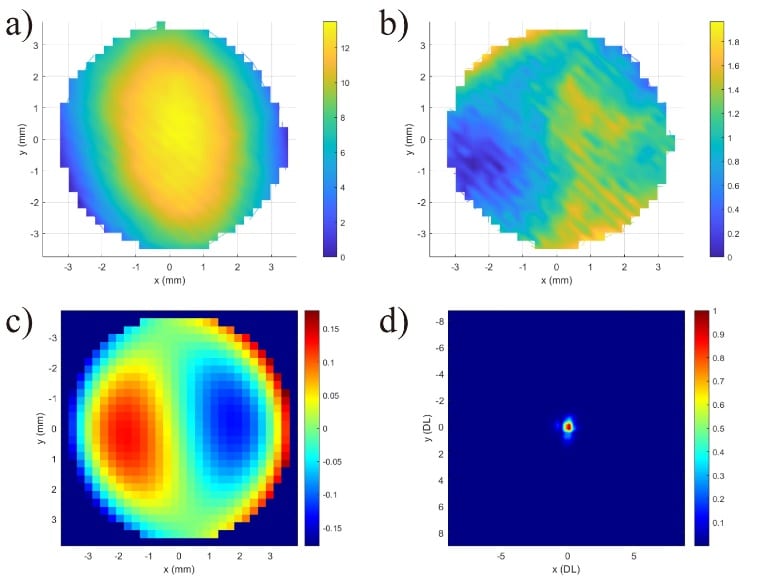
Figure 1 Beam characterization under coma modulation: (a) raw wavefront distribution before background subtraction; (b) wavefront distribution after background subtraction; (c) coma component extracted from (b); (d) far-field focal spot
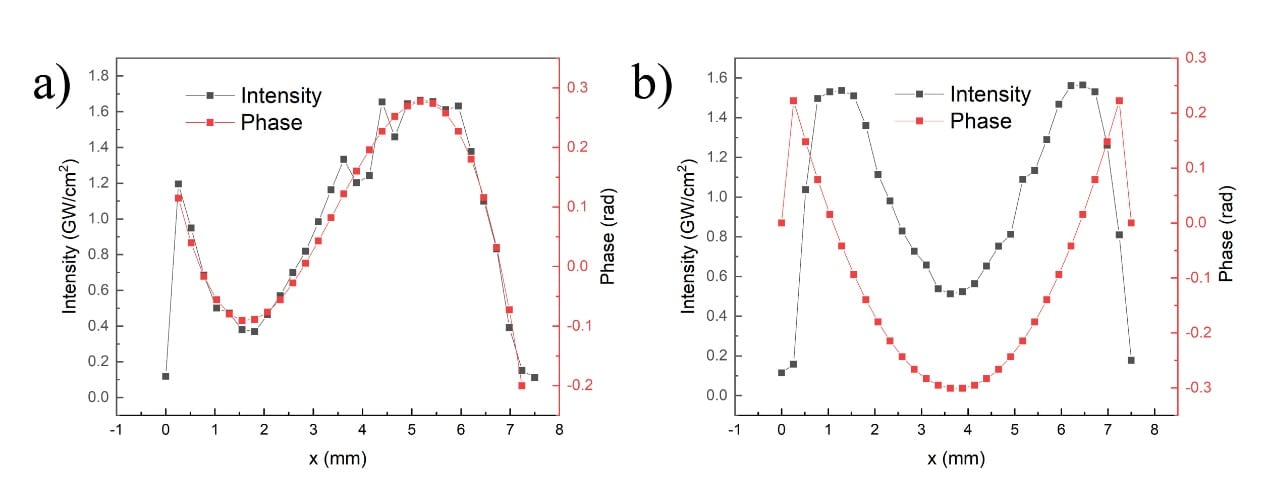
Figure 2 Intensity-phase results under (a) coma modulation and (b) inverse Gaussian modulation
Source: Shanghai Institute of Optics and Fine Mechanics (SIOM) · Research Updates · siom.cas.cn