NVIDIA Launches DSX POD, Targeting AI Factory Deployment in as Little as 14 Days with CPO Interconnects
Topics and contents
NVIDIA has launched DSX POD, a modular AI factory reference design expected to cut deployment time from about six months to as little as 14 days. The solution consists of 7 NVIDIA Vera Rubin NVL72 liquid-cooled racks, with a 17 km Scale-out network interconnected by fully mass-produced Spectrum-X co-packaged optics (CPO) Ethernet switches.
The explanation of the optical engine shifting from socketed to soldered design puts signal, cost and rework trade-offs into real deployment, providing concrete context for understanding CPO packaging choices.
C114 News, October 22 (Shui Yi): During NVIDIA GTC Berlin 2026, NVIDIA introduced the modular AI factory solution DSX POD, a complete reference design intended for partners to build full NVIDIA Vera Rubin AI factories inside modular shipping containers, with integration and validation completed before delivery. Deployment time is expected to drop from about six months to as little as 14 days.
DSX POD moves the integration and installation of compute, networking, cabling, rack-level power and liquid cooling into the manufacturing plant, eliminating the cumbersome planning, construction, specialized labor and logistics involved in traditional on-site builds. Containers that have undergone factory testing not only reduce the risk of delayed component deliveries, but also avoid costly and error-prone field work, opening a shorter path to model training and production inference so customers can start generating tokens and earning revenue sooner.
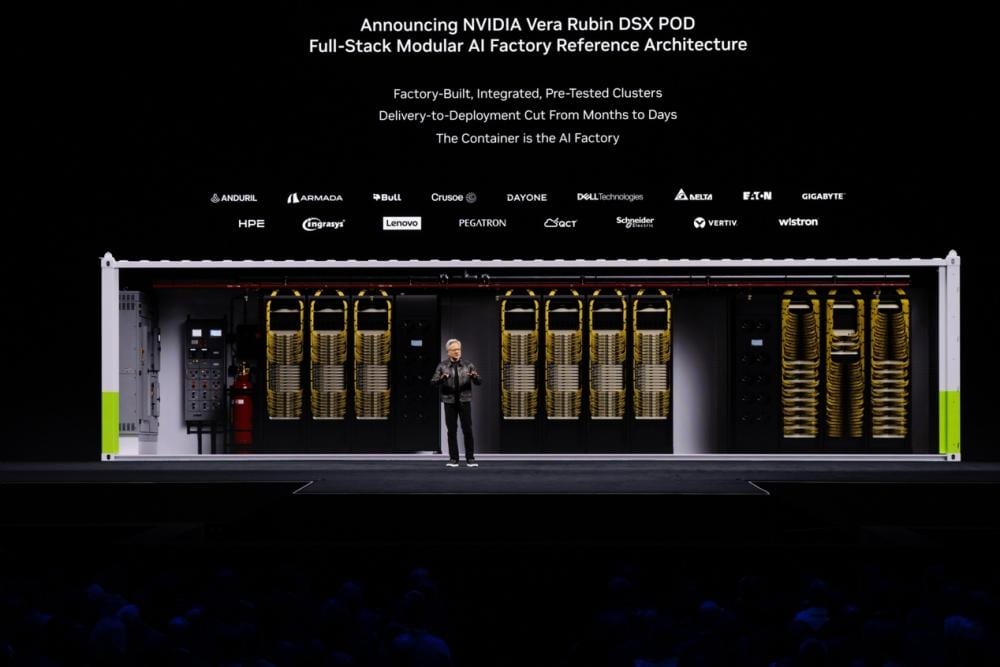
NVIDIA founder and CEO Jensen Huang: "The value of an AI factory begins when it starts producing tokens, not when construction ends. With NVIDIA DSX POD, we are bringing the precision and speed of factory manufacturing to AI infrastructure buildout, cutting deployment from months to weeks and helping customers scale capacity faster and bring revenue-generating production systems online sooner."
Jensen Huang previously did the math: a 1 GW data center requires $50 billion in investment and generates about $40 billion in annual revenue, so a three-month delay in commissioning means $10 billion in lost revenue. Compressing this process would sharply reduce idle compute capacity and capital expenditure.
"This is a complete transformation of the world's supply chain that will change how people install and build data centers," Jensen Huang emphasized.
A DSX POD consists of seven NVIDIA Vera Rubin NVL72 liquid-cooled racks, containing about 10 million parts and weighing approximately 28,000 kg. Inside are 20 km of copper cable, 3,500 cables and 17 km of scale-out networking. After factory integration, cabling and testing, the system is delivered as a transportable shipping container with 800 V DC power and a matching cooling system.
The 17 km scale-out network is interconnected via Spectrum-X. Spectrum-X is the world's first co-packaged optics (CPO) Ethernet switch announced by NVIDIA and is now in full-scale production. NVIDIA said partner Siliconware Precision Industries (SPIL) aims to increase optical engine capacity for CPO 15-fold by mid-2027 and double it again by the end of 2028.
On CPO serviceability, NVIDIA Chief Hardware Systems Architect Daniel Kuchta said at the 2026 OCP Global Summit that the InfiniBand CPO switch NVIDIA built earlier used six socketed optical engines, while the current Spectrum-X uses 32 soldered-down optical engines. In his view, sockets are useful only for rework on the production line; socketed modules do not necessarily mean they can be replaced on-site in the data center. Soldering, by contrast, delivers the best signal integrity, the smallest footprint and the lowest cost.
On the open ecosystem, Daniel Kuchta commented on the state of the NPO supply chain. He believes multi-source supply is not viable at present: today's NPO prototypes from different vendors are mutually incompatible, and there are four related multi-source agreements, all of them new. For NPO to reach the volumes forecast by LightCounting, early shipments will have to come from a single supplier across a large batch of products, and NPO is also difficult to service on-site. NVIDIA, however, will work with system contract manufacturers on NPO, and its own interconnect ecosystem will support it as well. CPO, pluggable optics and NPO are expected to coexist in scale-out networks. 
Source: C114 Communications Network · Optical Communications · c114.com.cn