How Four Diffractive Optical Waveguide Pathways Drive Volume Manufacturing
Topics and contents
SRG diffractive optical waveguides use four complementary pathways - nanoimprint, DUV lithography etching, SiC substrates and single-layer full color - to improve mass production, precision, field of view and image quality respectively. The article cites AAC Technologies' single-layer full-color SRG mass production yield of over 80%, a 52-degree FOV for the SiC solution, and the commissioning of Goertek Optics' 12-inch DUV lithography etching production line. Plans for million-unit-level capacity and ramp-up do not mean the industry as a whole has achieved stable million-unit-scale delivery; cost, yield and whole-device integration remain the next hurdles.
Discussing nanoimprint, DUV etching, SiC substrates and single-layer full color separately helps distinguish the constraints on waveguide mass production, precision, field of view and image quality.

Abstract: 2026 marks the industrialization watershed for SRG diffractive optical waveguides. Driven by four parallel technology pathways, the industry continues to break through, progressively clearing the four core bottlenecks of mass production, precision, field of view, and image quality.
Leading manufacturers are ramping up capacity in a concentrated push, with million-unit-scale mass production capability taking shape. SRG has officially moved beyond isolated technology validation and entered a cycle of large-scale commercial deployment.
Optical waveguides have been a hot industry topic for years, but 2026 is a true industrialization watershed.
Zhige Technology is pushing to deliver one million SRG waveguides this year, AAC Technologies' SRG production line has stably surpassed an 80% yield and is implementing a million-unit-scale capacity plan, Goertek Optics has officially put into production China's first 12-inch DUV lithography and etching mass production line, and Guangna Siwei has achieved large-scale deployment of silicon carbide full-color diffractive optical waveguides.
From laboratory sample fabrication to production lines capable of million-unit-scale mass production and delivery, the industrialization of SRG diffractive optical waveguides has completed four crucial technological leaps.
01 Mass production pathway: Nanoimprint turns SRG from samples into products
The first industrial hurdle for SRG diffractive optical waveguides is not optical design, but engineering mass production: how to stably and in volume fabricate high-precision nano-grating structures on glass substrates.
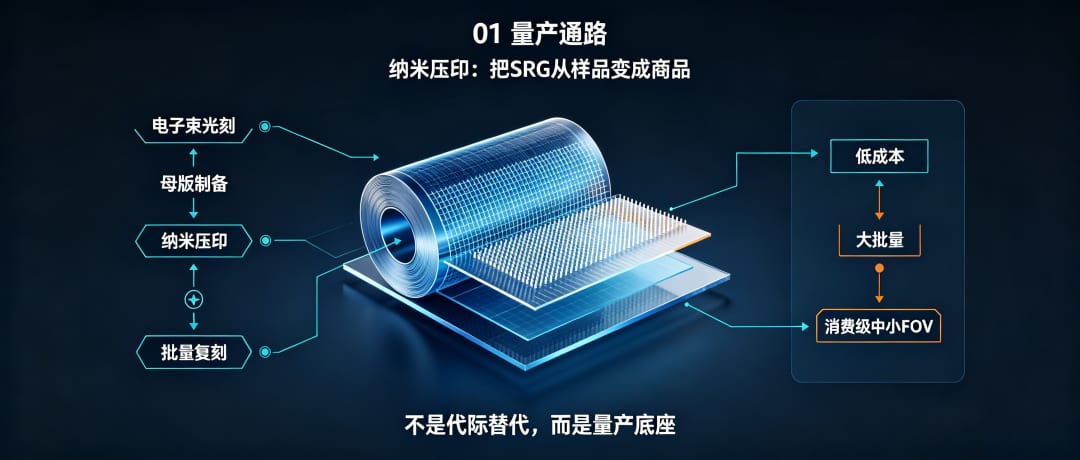
In the early days, the industry relied on electron-beam lithography with piece-by-piece processing, which was extremely inefficient and costly. It could only be used to validate laboratory samples and was entirely unsuitable for commercial deployment.
The successful implementation of UV nanoimprint lithography has completely reshaped the mass-production logic: using high-precision master molds to replicate nano-grating structures on glass substrates in volume, enabling low-cost, standardized, high-volume replication.
Guangna Siwei has now built a fully automated nanoimprint line with an annual capacity of millions of units. Its monochrome optical waveguide products are shipped in stable, continuous volume and have been adopted in several mass-produced AR glasses, including Even G1 and G2 from Yiwen Technology.
Nanoimprint has fully opened up the low-cost mass-production path for SRG and remains the mainstream process for consumer-grade optical waveguides with small to medium fields of view. However, due to the constraints of the process principle, it cannot fabricate high-precision gratings with large aspect ratios and large tilt angles, imposing a natural performance ceiling.
02 Precision pathway: DUV etching turns SRG from "can be made" into "made accurately"
Nanoimprint lithography solved the question of whether SRGs can be mass-produced, but it cannot break through the performance bottleneck.
The diffraction efficiency, field of view and image uniformity of SRG optical waveguides depend mainly on the precision of the grating tooth profile, trench depth and duty cycle. High-performance grating structures with large tilt angles and deep trenches remain a technical blind spot for conventional nanoimprint processes.

The industrialization of semiconductor-grade DUV lithography and etching has closed this gap. GoerTek Optics has launched China's first 12-inch wafer DUV lithography and etching mass-production line, supporting high-precision overlay alignment and integrated multi-layer grating processing. Its non-contact process effectively avoids lens scratches and surface contamination, expanding capacity while improving yield.
Built on this high-precision process platform, AAC Technologies' in-house single-layer full-color SRG mass-production yield has remained stable above 80%, far better than the industry average of 50%.
It should be noted that this high yield is the result of closed-loop control across the entire process of optical design, DUV lithography and etching, coating, inspection and module integration; it does not come automatically from simply installing DUV equipment.
DUV etching and nanoimprint are not iterative replacements for each other. Instead, they form complementary high-end and low-end process tiers that support stable mass production of high-end, high-precision SRG products.
03 Physical pathway: SiC pushes up the FOV ceiling of SRG
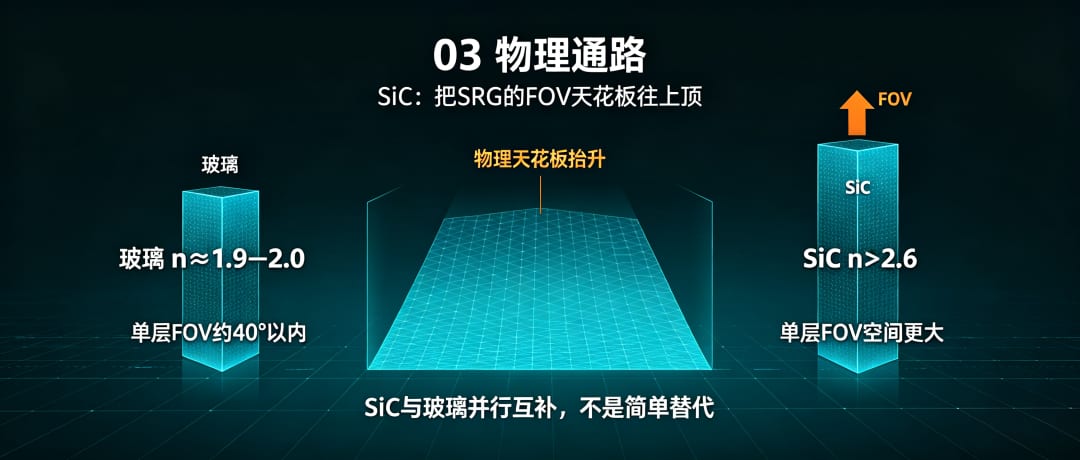
Once manufacturing precision is maxed out, the performance bottleneck of SRG optical waveguides is no longer engineering fabrication, but the physical limit of the substrate material.
Conventional optical glass has a refractive index of only 1.9-2.0. Constrained by the optical K domain, the field of view of a single-layer SRG waveguide is essentially capped at 40 degrees, making it hard to meet users' needs for an immersive AR experience.
The scaled-up use of silicon carbide has completely broken this physical constraint. Its refractive index exceeds 2.6, greatly expanding the etendue and unlocking a wider field-of-view range.
AAC Technologies' high-end SiC substrate SRG solution can achieve a 52-degree FOV, effectively suppressing rainbow artifacts in full-color displays. With a color deviation of Δu'v' below 0.02, image colors are more balanced and pure.
According to publicly released industry figures from Guangna Siwei, it has achieved the world's first mass production of silicon carbide-etched full-color diffractive optical waveguides. The products are less than 0.6mm thick and weigh under 3g per piece, and have been deployed in volume in Coray Air2 commercial AR glasses.
To be clear, SiC is an upgrade at the substrate material level, not a replacement for the traditional glass SRG process system. Instead, it opens up new performance boundaries in wide field-of-view and low-dispersion scenarios where glass materials cannot make breakthroughs, forming a parallel and complementary relationship with glass solutions.
04 Image Quality Path: Single-Layer Full Color Takes AR from Information Prompts to Immersive Display
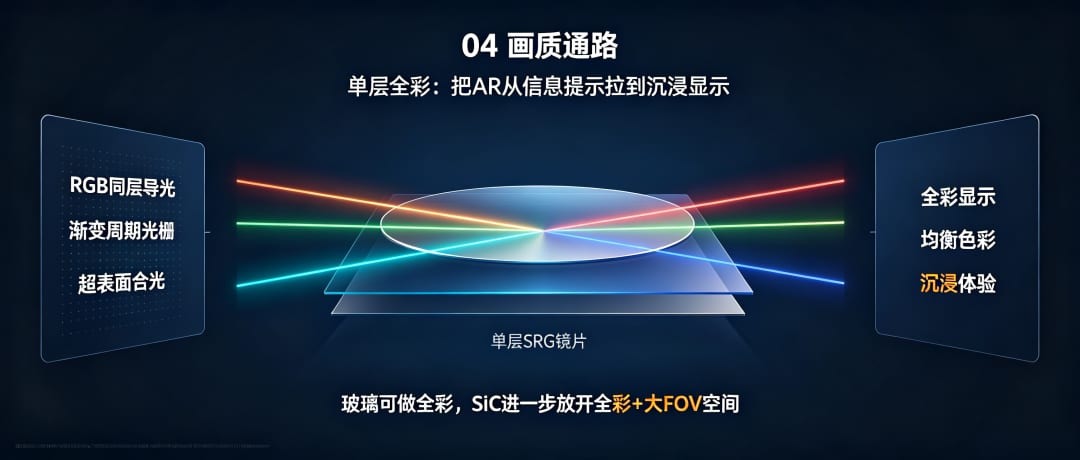
With the three conditions of wide field of view, high precision and mass production in place, image quality improvement has become the final core piece of the SRG optical waveguide puzzle.
Monochrome optical waveguides can only support basic information prompt interactions. To enable AR devices to evolve from lightweight tool interaction into immersive visual experiences, full color is an irreversible industry trend.
Industry technology solutions are evolving from bulky multi-layer stacked light-combining structures to lightweight single-layer full-color SRG technology roadmaps.
AAC Technologies' self-developed single-layer full-color optical waveguide is only 0.7mm thick and weighs 4g, more than 50% lighter than conventional glass optical waveguides of the same specification, while the lens ambient light transmittance exceeds 90%, combining an excellent wearing experience with high-definition display performance.
Guangna Siwei's C25C monolithic full-color optical waveguide has also entered stable mass production, meeting the upgrade needs of mainstream consumer AR devices.
The core technical challenge of full-color implementation is achieving efficient in-coupling, out-coupling, and balanced transmission of RGB light within a single waveguide layer. As technologies such as gradient-period gratings and metasurface beam combining continue to mature, SRG full-color image quality has moved from laboratory demonstrations to a standard feature in mass-produced consumer products.
05 2026 Industry Inflection Point: From Single-Point Validation to Full-Chain Capability
Four differentiated technology pathways reinforce one another, fully resolving the core bottlenecks of SRG waveguides across four dimensions: mass production, precision, performance, and image quality.
In 2026, the industry reached a critical turning point: SRG breakthroughs are no longer isolated technical highlights, but the formation of end-to-end, large-scale capabilities.
According to Counterpoint Research industry data for Q1 2026, the AR glasses market structure is rapidly evolving. The market share of traditional Birdbath and flat-prism solutions has shrunk from 82% to 58%, while waveguide AR glasses have surged from 18% in the same period last year to 42%.
Multiple industry organizations forecast that global AR glasses shipments will enter the millions of units in 2026.
Capacity is ramping up in parallel: Zhige Technology is racing to deliver 1 million waveguides this year, AAC Technologies' plan for capacity at the million-unit level is steadily materializing with stable monthly shipment growth, and companies including Guangna Siwei, Gudong Intelligence, Mojie Technology and LiPi Photonics are raising funds and expanding capacity in rapid succession.
This is not a technological breakthrough by a single company, nor does it mean the entire industry has achieved stable delivery at the million-unit scale. Rather, it marks the first time the full optical waveguide supply chain has closed the loop on end-to-end capabilities.
From master mold preparation and precision machining to specialty material supply and standardized testing systems, every segment has completed scaled adaptation in step, putting an end to the industry's longstanding pattern of isolated technology trials that never reached production.
Final Thoughts
A review of the four core breakthroughs in SRG diffractive optical waveguides shows that this is not a chain of generational replacement between old and new technologies, but four parallel, mutually reinforcing upgrade paths that continuously raise the industry's ceiling.
Nanoimprint lithography has opened the path to volume production, solving the industry's "whether it can be made" problem; DUV etching raises manufacturing precision, addressing the "how good it is" question; SiC material breaks through physical constraints and lifts the industry's field-of-view ceiling; single-layer full-color display schemes iterate and upgrade immersive image quality on end devices.
These four technology paths reinforce one another without replacing each other, jointly driving the AR optical waveguide industry forward.
The million-unit-level capacity race beginning in 2026 marks the moment the door from sample development to mass production of SRG waveguides has been fully opened.
But established mass-production capability does not mean full adoption in the consumer market. Beyond that door, hurdles remain, including continued cost reduction, stable yield control, system-level adaptation and optimization, and the arrival of killer applications. This is only the new starting point for the scaled, mainstream rollout of AR optical waveguides.
Discussion topic: Of the four technological leaps in SRG, which do you think contributed the most to industrialization? Was it nanoimprint breaking the ice for mass production, DUV etching raising precision, SiC enabling a large FOV breakthrough, or single-layer full-color transforming image quality? Share your view in the comments.
- AR Andy | Focused on optical waveguides and AR microdisplays, with in-depth analysis of the underlying logic of the optics industry
[Risk Notice] This article is compiled from publicly disclosed company materials and publicly available industry data. It is intended solely for industry perspectives and technical education. Processes and specifications vary among vendors and do not constitute technical selection or investment advice.
Original title : Four Leaps in Diffractive Optical Waveguides: From "Displayable" to "Mass-Producible"
Source: OFweek Optics Network · News · optics.ofweek.com