SIOM Uses Improved YOLOv8-seg for Intelligent Laser Spot Analysis in High-Power Laser Facilities
Topics and contents
The Joint Laboratory for High Power Laser and Physics at the Shanghai Institute of Optics and Fine Mechanics (SIOM) has proposed a laser spot analysis system based on an improved YOLOv8-seg to meet the need for rapid, precise alignment of optics along the full chain of high-power laser facilities, and has completed experimental validation.
The original paper demonstrates a deep learning segmentation model for laser facility alignment, a case of AI entering optical assembly and adjustment
Shanghai Institute of Optics and Fine Mechanics Reports Progress in Intelligent Spot Analysis for High-Power Laser Facilities
Recently, a research team from the Joint Laboratory for High-Power Laser Physics at the Shanghai Institute of Optics and Fine Mechanics, Chinese Academy of Sciences, proposed a spot analysis system based on an improved YOLOv8-seg to meet the need for rapid, precise alignment of optical components across the full chain of high-power laser facilities, and carried out experimental validation. The related results were published in High Power Laser Science and Engineering under the title “A spot analysis system for high-power laser facilities based on an improved YOLOv8-seg model”.
Research on inertial confinement fusion and related fields places ever-higher demands on the output capability of high-power laser drivers. Whether the large number of optical components in a facility can be precisely aligned directly affects beam quality and final output performance, while the spot morphology and center position are the most direct indicators of beam quality and spatial alignment status. Conventional threshold segmentation, edge detection and centroid algorithms tend to fail under low contrast, non-uniform illumination, overlapping boundaries, noise and stray light, making it difficult to meet the demands of large facilities for high-precision, rapid automatic alignment across multiple beamlines in parallel and without human supervision.
To address these issues, the team built on the YOLOv8-seg instance segmentation model, introducing the CBAM attention mechanism, dynamic multi-scale feature fusion and a circularity-constrained loss function, improving the algorithm's ability to recognize spots of low contrast, weak boundaries and varying morphologies and to segment their contours at the pixel level. For reference center determination, they designed a three-level progressive reference-center detection framework of “four-hole pattern—cross marker—image geometric center,” ensuring stable recognition of the spatial reference under conditions such as occlusion, wear and strong stray light. The segmentation results are then fed into a feature quantification module that automatically calculates parameters including spot centroid, area, perimeter, circularity, equivalent radius and offset distance relative to the reference center.
Bench experimental results show that the improved model achieves an mAP@0.5 of 0.901 (a 3.33% improvement over the baseline), a single-frame inference time of 55±2 ms, only 2.65×10⁷ parameters, 2.1 GB of inference memory, a three-level reference-center detection localization error of 1.9 pixels and a success rate of 98.7%. Compared with mainstream methods such as U-Net, Mask R-CNN, DeepLabv3+ and SegFormer, the system achieves a better balance among segmentation accuracy, inference speed and resource consumption.
The system has now completed offline testing and validation, and the team is conducting performance tests using the facility's latest alignment sampling data. Once engineering requirements are met, online validation will proceed. Future work will focus on model lightweighting, online incremental learning and digital-twin predictive control, driving facility alignment toward intelligent, autonomous operation.
This work was supported by the Shenguang-II laser facility operation project (No. 86CL020101).
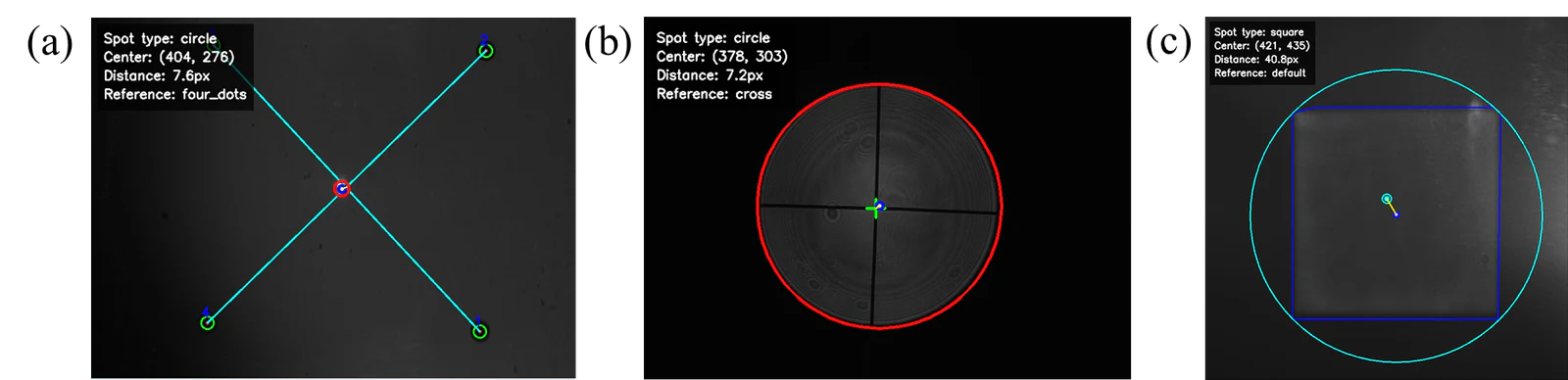
Figure 1 Detection results of three types of reference centers: (a) four-hole pattern; (b) cross marker; (c) image geometric center.
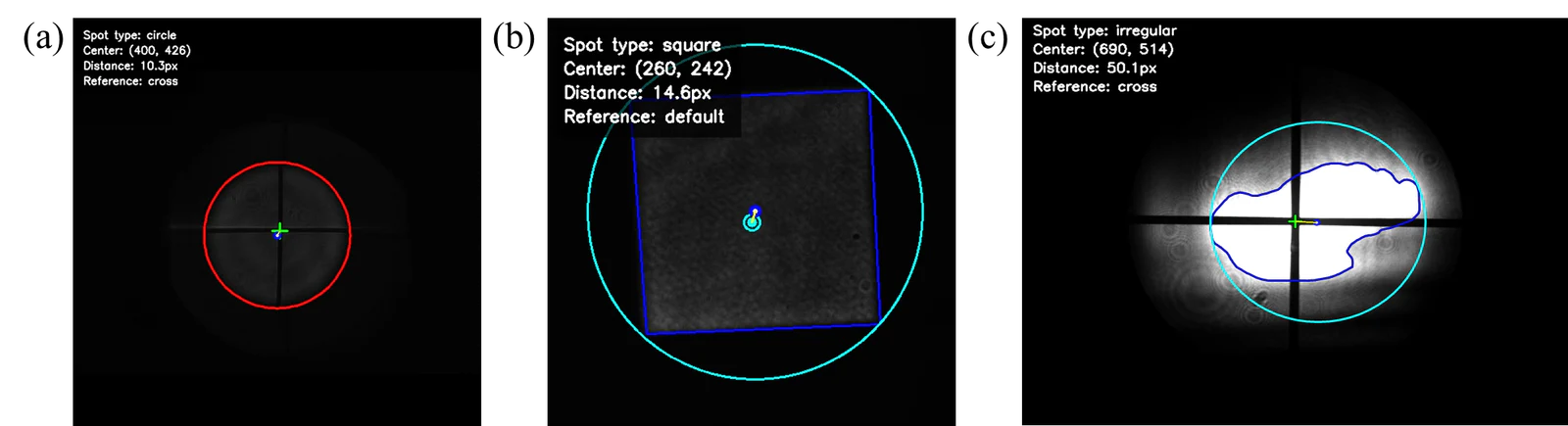
Figure 2 Segmentation results for three typical spot shapes: (a) circular; (b) square; (c) irregular.
Source: Shanghai Institute of Optics and Fine Mechanics (SIOM) · Research Updates · siom.cas.cn