Russell Center and Partners Report in Optica: Hollow-Core Photonic Crystal Fiber Enables Flexible Delivery of Near-Watt, Hundred-Femtosecond 2.8 µm Mid-Infrared Pulses
Topics and contents
The Russell Advanced Lightwave Science Center at the Hangzhou Institute of Optics and Mechanics, together with the Hangzhou Institute for Advanced Study of UCAS, the Shanghai Institute of Optics and Mechanics, and IRFIBER (Ningbo) Optoelectronics Co., Ltd., published a paper in Optica on delivering near-watt, hundred-femtosecond mid-infrared pulses in the 2.8 µm band through a 5 m-long hollow-core photonic crystal fiber with a single-core, eight-ring structure. After evacuation, overall efficiency exceeded 70%, the output was a near-diffraction-limited Gaussian spot, and the fundamental-mode energy fraction exceeded 95%.
The paper gives efficiency, pulse duration, peak power and fundamental-mode fraction, and compares the fiber with free-space optics and solid-core fluoride fiber, making it easier to judge the applicability of hollow-core fiber to mid-infrared ultrafast delivery.
Recently, the Russell Advanced Optical Wave Science Center at the Hangzhou Institute of Optics, together with the Hangzhou Institute for Advanced Study, UCAS, the Shanghai Institute of Optics and Fine Mechanics, Chinese Academy of Sciences, and Effibo (Ningbo) Optoelectronic Technology Co., Ltd., published its latest findings in the leading international optics journal Optica. The work achieved, for the first time, efficient, high-fidelity, flexible delivery of near-watt-level, hundred-femtosecond mid-infrared pulses at 2.8 μm in a hollow-core photonic crystal fiber (Hollow-core PCF), with high single-mode purity. The result not only offers an effective solution to the shortcomings of transmitting mid-infrared ultrafast pulses, but also lays the foundation for expanding the applications of mid-infrared lasers.
High-power, mid-infrared ultrafast broadband sources have important applications in advanced spectroscopy, precision materials processing, medical surgery and remote sensing, but limitations in laser delivery have hindered further expansion of mid-infrared laser applications. In conventional delivery schemes, free-space beam paths suffer absorption by various gas molecules, distorting the output beam profile and degrading pulse quality, while solid-core mid-infrared fibers accumulate severe nonlinearity, causing serious distortion of the output time-frequency signal. To address this, the team used a custom-made Hollow-core PCF with a single-hole, eight-ring structure (5 m long) to deliver the mid-infrared ultrafast pulses. Thanks to the Hollow-core PCF's low transmission loss, low nonlinear accumulation and support for rapid evacuation, the team not only overcame the problems of conventional delivery methods, but also achieved efficient delivery with overall efficiency >70%.
In the experiment, the researchers used a home-built mid-infrared pulsed fiber laser as the source and a 5 m Hollow-core PCF as the delivery medium, with both ends of the fiber fixed in gas cells so that a vacuum pump could evacuate the Hollow-core PCF. After evacuation (the entire process took less than 1 min, with pressure reduced to ~10 mbar), the team achieved overall laser efficiency > 70% and a near-diffraction-limited Gaussian output beam, and the complete system showed excellent stability. In addition, the output spectral shape in the frequency domain was essentially identical to the input. In the time domain, because the Hollow-core PCF has a small amount of waveguide dispersion (-2.04 fs2/mm @ 2.8 μm), the pulse width broadened from 117 fs at the input to 404 fs. The researchers then added Ge and ZnSe positive-dispersion materials to compensate the negative dispersion introduced by the Hollow-core PCF, coupling lenses and gas-cell windows, obtaining an output pulse width of 98 fs (close to the 96 fs transform-limited width) and a peak power of 170 kW. In addition, the researchers used autocorrelation traces to estimate that the fundamental-mode energy fraction of the output exceeded 95%.
The researchers also compared this delivery scheme with a free-space path of the same length and a solid-core fluoride fiber. The results showed that during ultrafast pulse delivery, the solid-core fluoride fiber's excessively strong nonlinear effects caused temporal pulse splitting accompanied by a clear spectral red shift, confirming the unique advantages of hollow-core photonic crystal fiber for delivering high-peak-power mid-infrared ultrafast pulses. The experiment demonstrated efficient, high-fidelity, high-single-mode-purity flexible delivery of mid-infrared laser light, laying a solid foundation for applications of broadband mid-infrared ultrafast sources in spectroscopy, infrared countermeasures and remote sensing.
The results were published in the top journal Optica under the title "Flexible delivery of broadband, 100 fs mid-infrared pulses in the water-absorption band using hollow-core photonic crystal fiber". Lin Wei, a jointly supervised doctoral student of the Shanghai Institute of Optics and Fine Mechanics and the Hangzhou Institute for Advanced Study, UCAS, and Li Zeqing, a doctoral student at the Shanghai Institute of Optics and Fine Mechanics, are co-first authors. Researcher Huang Jiapeng, Researcher Jiang Xin and Researcher Pang Meng of the Russell Center are co-corresponding authors.
Original article link: https://doi.org/10.1364/OPTICA.558579 (For paper details, click "Read the original article" at the end of the text)
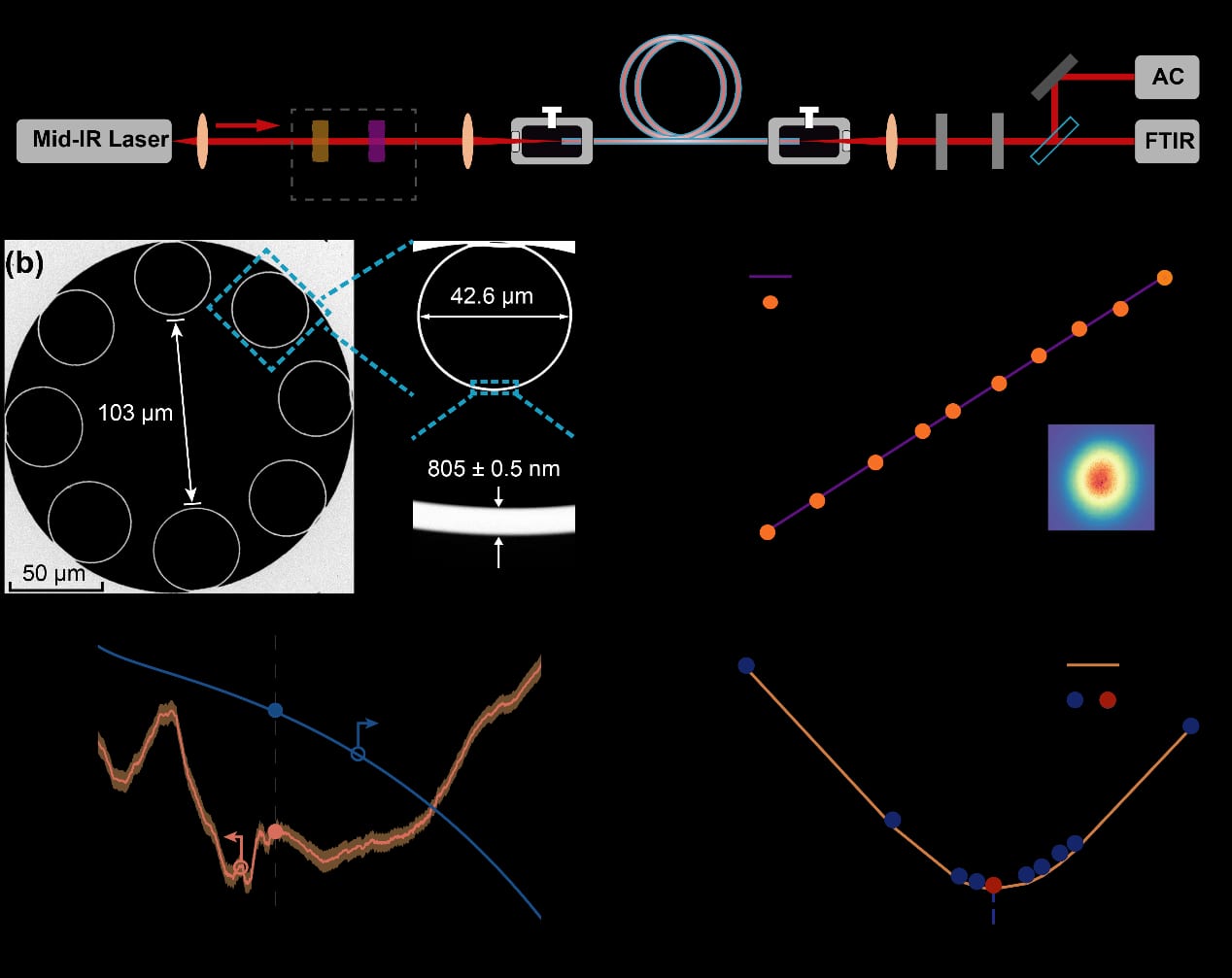
Figure 1. Experimental setup and results. (a) Experimental optical path. Lens, coated CaF2 plano-convex lens; HWP, half-wave plate; QWP, quarter-wave plate; FM, flip mirror; FTIR, Fourier transform infrared spectrometer; AC, autocorrelator. (b) SEM image of the fiber structure. (c) Loss spectrum measured by the cutback method, with the shaded region indicating measurement uncertainty (orange, left axis), and the calculated dispersion curve (blue, right axis). (d) Output power through a 5 m long Hollow-core PCF. (e) Using 30 mm of ZnSe and 5 mm of Ge, pulse output with a near-transform-limited pulse width of 98 fs was achieved.
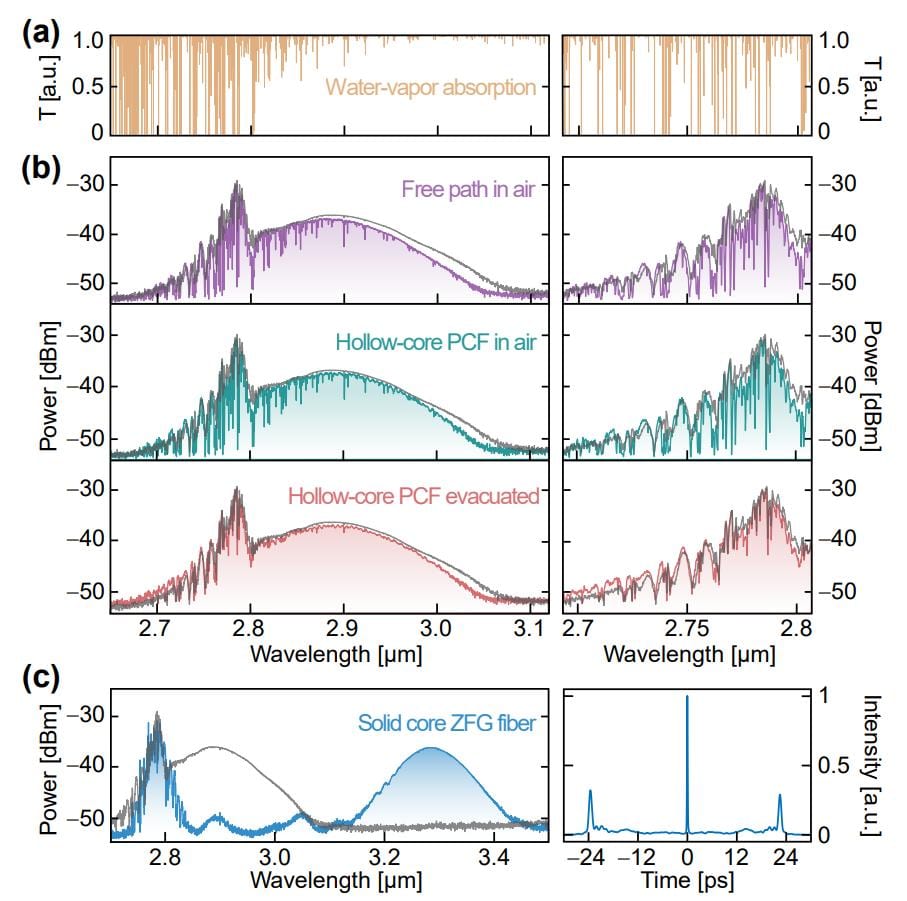
Figure 2. Comparison of different delivery methods. (a) Normalized absorption spectrum of water vapor. (b) Direct laser output (gray), transmission spectrum in the free-space beam path (purple), transmission spectrum of the Hollow-core PCF in air (green), and transmission spectrum of the Hollow-core PCF in vacuum (red). The right panel shows the enlarged spectra in the 2.7-2.8 μm range. (c) Raman soliton generation in a solid-core fluoride fiber. Left: FTIR spectra; right: autocorrelation traces.
Source: Hangzhou Institute of Optics and Fine Mechanics · Recent Highlights · hiom.ac.cn