Silicon Photonics Chip Maker Xihe Technology Files Registration Version of STAR Market Prospectus
光互连底座:硅光芯片厂商羲禾科技将登陆科创板
Topics and contents
Shanghai Xihe Technology has released the registration version of its IPO prospectus for the STAR Market, describing itself as one of the world's leading suppliers of silicon photonic integrated chips. Its customers include leading optical module makers and cloud service providers, and its products are already shipping at scale into AI clusters and hyperscale data centers. According to estimates by optical module makers, silicon photonics solutions can reduce total cost by nearly 20% and the volume of components within the module by nearly 30% at the same data rate and distance.
The original article provides cost and size data for silicon photonics versus discrete components, helping readers understand the domestic supply chain for AI data center optical interconnects
C114, October 15 (Nanshan) — Yesterday, silicon photonics chip maker Shanghai Xihe Technology Co., Ltd. released its Prospectus for Initial Public Offering and Listing on the STAR Market (Registration Draft).
Xihe Technology said it is one of the world's leading suppliers of silicon photonic integrated chips, with downstream customers including leading global optical module makers and cloud service providers. Its current main products are already supplied at scale in AI clusters and hyperscale data centers, and the company has expanded into data center interconnects and silicon photonic sensing. According to optical module makers' estimates, at the same transmission rate and distance, silicon photonics solutions can cut total cost by nearly 20% and reduce in-module component volume by nearly 30%, while outperforming discrete optoelectronic device solutions in power consumption and reliability, lowering system power use in large model training and improving network stability. Silicon photonic integration is becoming the mainstream optical interconnect solution in today's compute infrastructure buildout, serving as the core technology foundation for next-generation optical interconnect architectures such as NPO, CPO and OIO, and is gradually expanding into diversified scenarios including autonomous driving, wearables, industrial and medical applications.
In this IPO, Xihe Technology plans to raise RMB 1.83 billion. Net proceeds after issuance expenses will mainly go to a project to expand the industrialization capacity of silicon photonic integrated chips for AI compute and data centers, a next-generation silicon photonic integrated chip R&D and industrialization project, and an R&D center construction project.
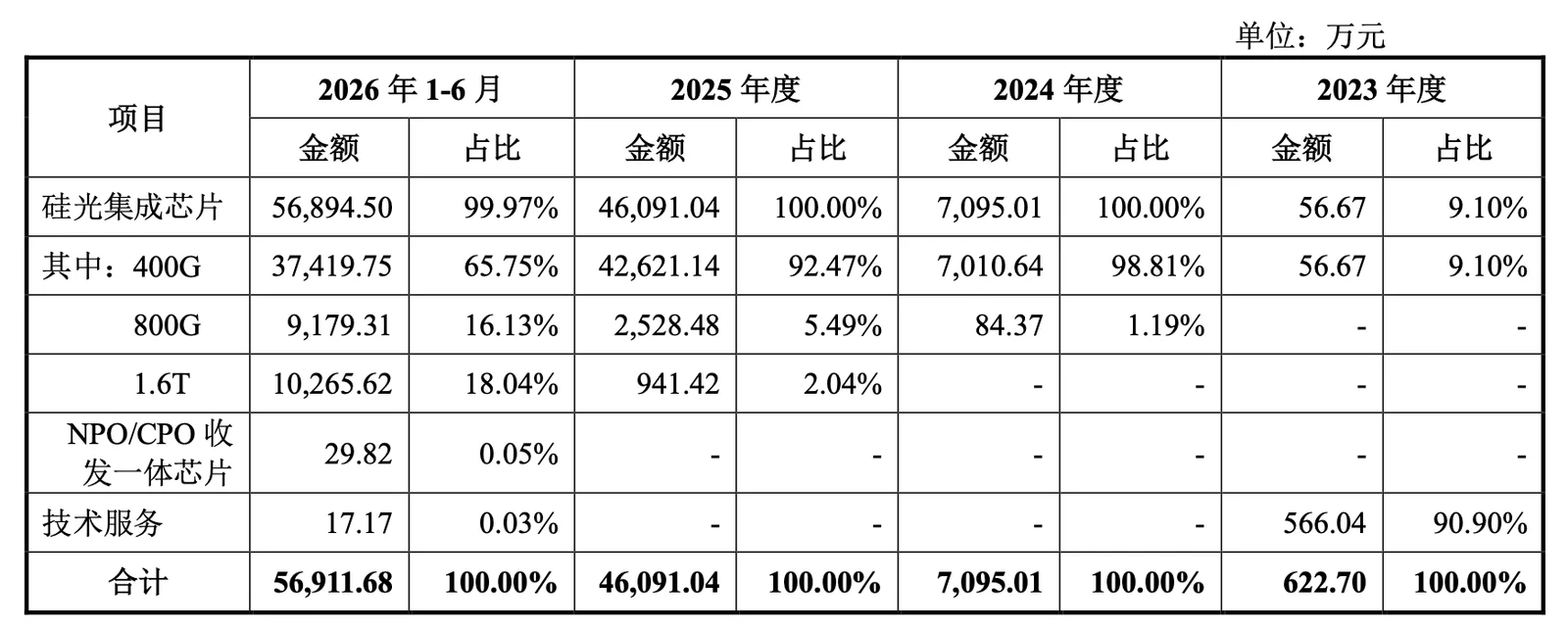
In terms of performance, Xihe Technology sells its silicon photonic integrated chips to major optical module makers at home and abroad, ultimately used in global AI clusters and hyperscale data centers. The company posted revenue of RMB 461 million in 2025, up 549.63% year on year, and revenue of RMB 569 million in January-June 2026, marking explosive growth. A breakdown by product follows:
On staffing, Xihe Technology had 28 employees at the end of 2023; as of the first half of 2026, total headcount stood at 123, including 51 R&D staff, or 41.46%.
The prospectus shows that silicon photonic integrated chip makers in the current competitive landscape fall into three main categories. The first comprises diversified platform companies represented by Intel and Cisco, for whom silicon photonics is part of a broader business portfolio, serving both their own ecosystems and the open market. The second comprises leading optical module makers such as Innolight and Eoptolink, which extend upstream into chips based on their own supply chain footprint; their in-house silicon photonic integrated chips mainly fit their own silicon photonic modules. Innolight, for example, has disclosed that a subsidiary develops silicon photonic integrated chips, while Eoptolink has also disclosed that it has built a silicon photonic integrated chip R&D framework. The third comprises independent third-party suppliers represented by Xihe Technology, which supply silicon photonic integrated chips to the entire market. Of these players, all focus mainly on the datacom sector except Cisco, which focuses mainly on telecom.
According to Frost & Sullivan data, Xihe Technology held a global market share of about 13% in silicon photonic integrated chips in 2025, making it a leading global supplier and one of the world's foremost independent third-party silicon photonic integrated chip design companies.
The prospectus shows that founder and CEO Dr. Wu Aimin has long been engaged in cutting-edge exploration of silicon photonic integration technology, winning honors including the Shanghai Natural Science First Prize, Jiangsu Science and Technology Progress Second Prize, Shanghai Outstanding Academic Leader and national-level innovative talent. The company's team led development of the world's first VOA chip based on silicon photonic integration technology and brought it into volume production at Kotura, one of the earliest companies worldwide to develop silicon photonics (acquired by Mellanox in 2013). It was the only silicon photonic product on the market at the time capable of high-performance tunable optical attenuation, and was widely used in telecom networks, data centers and other fields, building a rich customer base and strong market reputation. Among them, founding team member and CTO Dr. Feng Dazeng was formerly vice president of Mellanox (acquired by NVIDIA in 2020), while core technical staff Wang Yiqiong and Liang Hong led silicon photonic process and packaging/testing respectively at Mellanox. The core team has deep technical expertise and industrialization experience.

Source: C114 Communications Network · Optical Communications · c114.com.cn