Changchun Institute of Optics Develops Goblet-Shaped Waveguide Mid-IR QCL with Low-Power Room-Temperature Output
长春光机所在低功耗中红外量子级联激光器方面取得新突破
Topics and contents
A team led by researcher Meng Bo at the Changchun Institute of Optics, Fine Mechanics and Physics published a paper in Laser & Photonics Reviews presenting a mid-infrared quantum cascade laser with a goblet-shaped waveguide structure. The active region is formed by selective wet etching, eliminating the semi-insulating InP lateral regrowth process. A 1 mm × 3 μm device achieved a continuous-wave threshold power of about 1 W at 293 K, an output power above 27 mW, and a room-temperature pulsed wall-plug efficiency of 3.9%. A 2 μm-wide device maintained stable single-mode lasing across the entire current range, with a side-mode suppression ratio of about 20 dB.
The goblet-shaped waveguide eliminates the semi-insulating InP regrowth step through selective wet etching. The paper reports room-temperature continuous-wave threshold power and wall-plug efficiency, which can be compared with buried-heterostructure devices.
Changchun Optics Institute Achieves New Breakthrough in Low-Power Mid-Infrared Quantum Cascade Lasers
Published: 2026-07-24
Recently, a team led by Researcher Meng Bo at the Changchun Institute of Optics, Fine Mechanics and Physics, Chinese Academy of Sciences, proposed a quantum cascade laser with a goblet-shaped waveguide structure, achieving low-power laser output at room temperature. The findings were published in the authoritative optics journal Laser & Photonics Reviews under the title "Low power dissipation goblet quantum cascade laser." The co-first authors are master's student Zhang Lequan and doctoral student Liu Peng, with Researcher Meng Bo as corresponding author.
The mid-infrared band is known as the "molecular fingerprint region," as vibrational-rotational transitions of numerous gases and biomolecules occur in this range, giving it irreplaceable value in gas sensing, environmental monitoring, medical diagnostics and other fields. However, mid-infrared quantum cascade lasers (QCLs) face bottlenecks including high power consumption, complex fabrication and high cost, severely hindering the practical deployment of portable infrared systems.
Goblet-Shaped Waveguide Structure
The core design concept is to selectively wet-etch the active region so that its width is far smaller than that of the upper and lower cladding layers, creating a cross-sectional profile resembling a "goblet." This design offers three major advantages:
Process simplification: The design eliminates the semi-insulating InP (SI-InP) lateral regrowth step required by conventional low-power devices, significantly reducing manufacturing cost and improving yield.
Current injection optimization: A relatively thick upper cladding is retained to ensure uniform and efficient current injection.
Enhanced thermal management: The extended InP cladding provides additional heat dissipation paths, effectively alleviating the thermal bottleneck caused by the SiO₂ passivation layer.
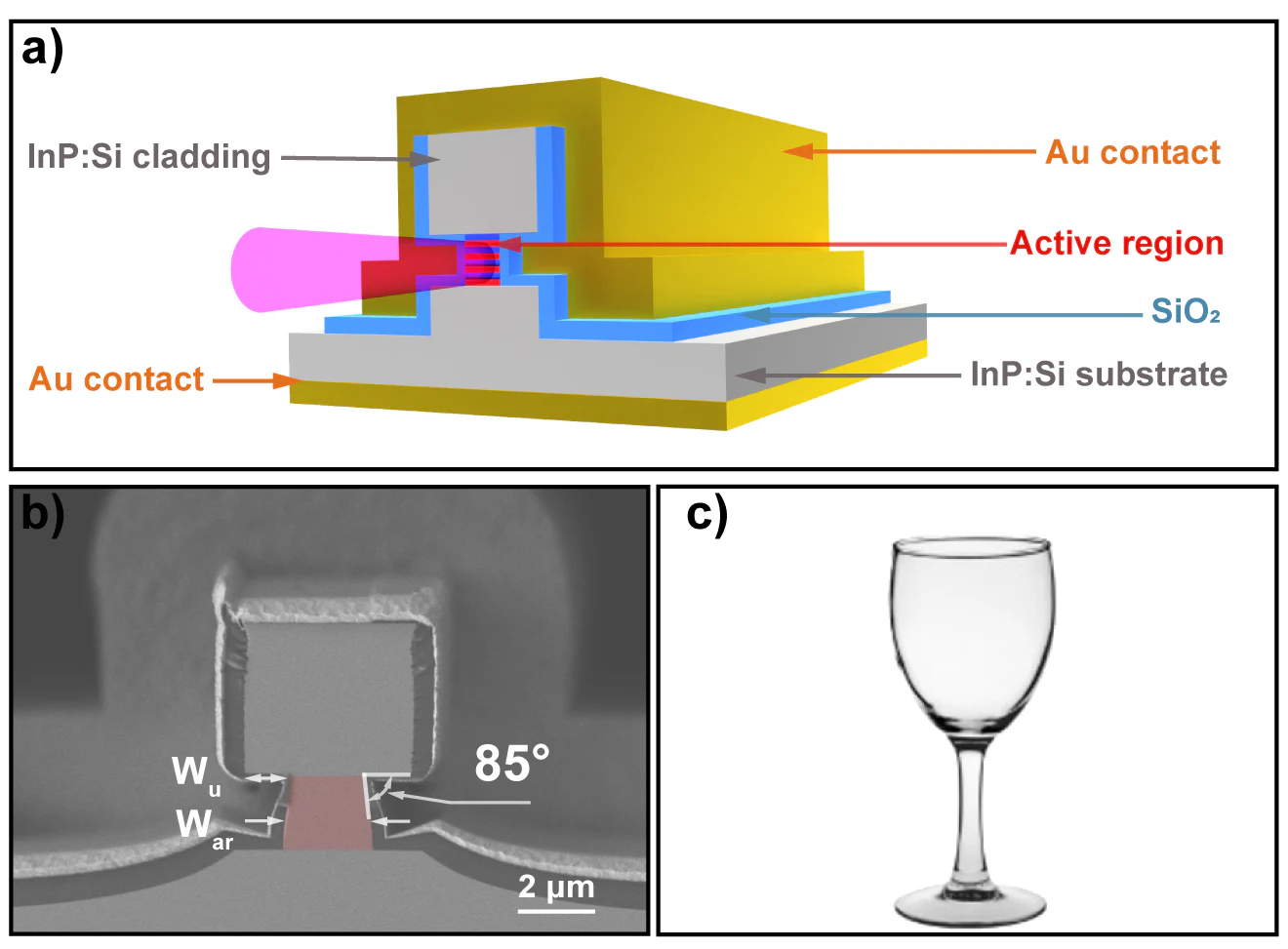
Goblet quantum cascade lasers
Low-power performance
The research team fabricated more than 50 goblet-shaped QCL devices of different sizes and systematically evaluated their optoelectronic performance. Key results include:
Low room-temperature continuous-wave (CW) power consumption: For a 1 mm × 3 μm device, a CW threshold power of about 1 W was achieved at room temperature (293 K), with a pulsed threshold power as low as 0.85 W
High output power: The device delivered an output power of over 27 mW under room-temperature CW operation; at low temperature (243 K), the maximum CW output power reached 83 mW, and 130 mW in pulsed mode
Excellent electro-optical conversion efficiency: At room temperature, the wall-plug efficiency (WPE) reached 3.9% in pulsed mode and 1.6% in CW mode; at low temperature, these rose to 6.4% and 4.9%, respectively, on par with buried heterostructure devices.
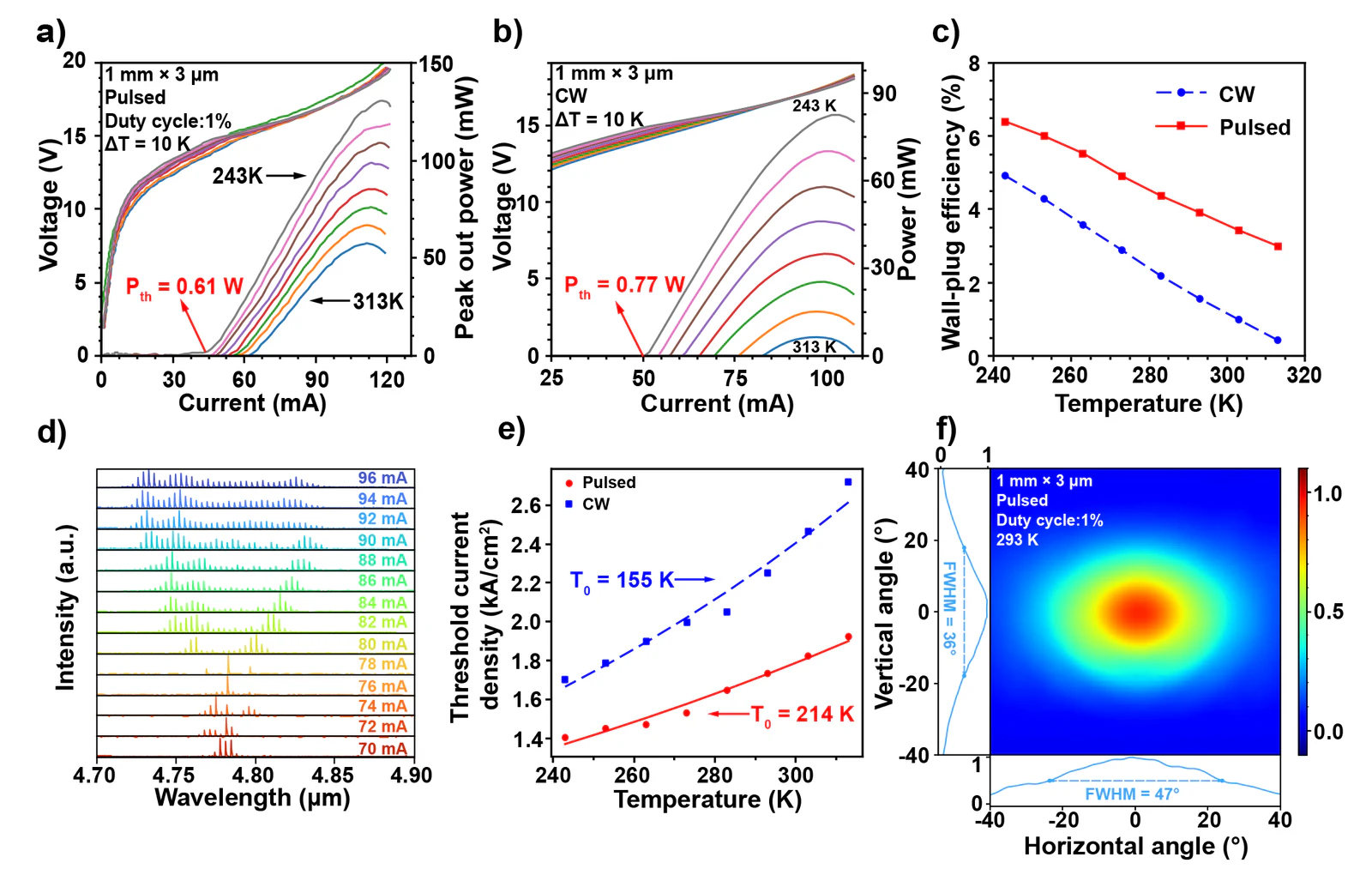
Performance characterization of the Goblet quantum cascade laser
High reliability
The team conducted a 25-hour continuous-operation reliability test on the device. Driven at the roll-over current point, the device maintained a stable CW output power of 370 mW, with a maximum power fluctuation of only 1.9 mW, fully demonstrating the thermal stability and structural robustness of the high-goblet structure under high-power injection.

Reliability characterization of Goblet quantum cascade lasers
Single-frequency lasers
Notably, the narrowest 2 μm wide device achieved stable single-mode lasing across the entire current dynamic range, with a side-mode suppression ratio of about 20 dB and a current tuning rate of 0.14 nm/mA. This single-mode behavior stems from a mode threshold increase caused by reduced modal gain in the narrow waveguide, and requires no wavelength-selective elements, offering a new approach for on-chip integrated single-frequency mid-infrared light sources.
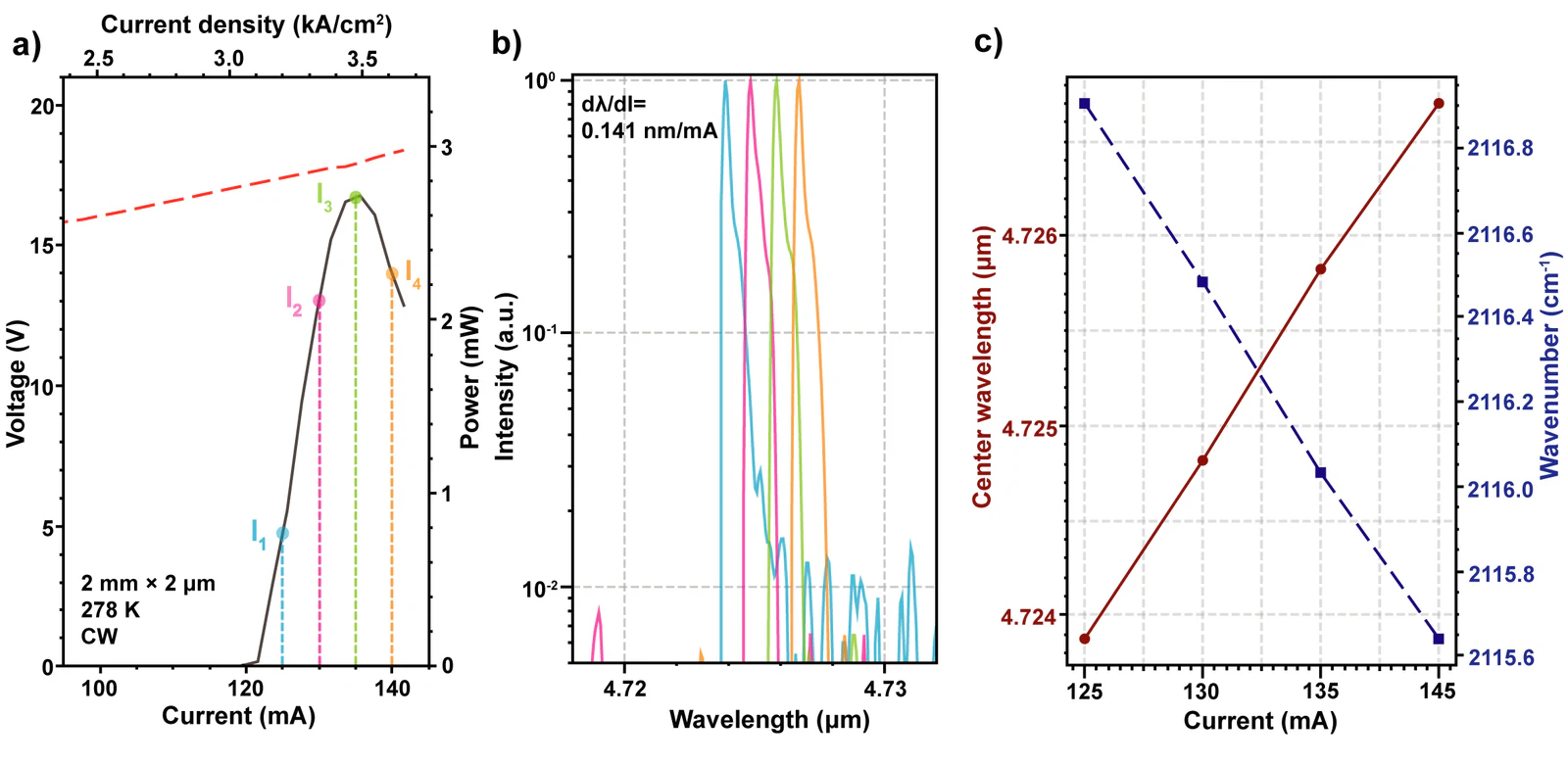
Single-frequency spectra of Goblet quantum cascade lasers
Low-power mid-infrared lasers broaden application prospects
The study provides a laser source solution combining low cost, low power consumption and high reliability for frontier applications such as portable mid-infrared sensing systems, high-speed free-space optical communications, and on-chip nonlinear photonics.
This work was supported by the National Natural Science Foundation of China, the Jilin Province Science and Technology Development Plan, and other projects.
Original article: https://doi.org/10.1002/lpor.71608
Source: Changchun Institute of Optics, Fine Mechanics and Physics (CIOMP) · Research Progress · ciomp.cas.cn