Fraunhofer IAF Diamond Laser System Achieves 100% Optical Contrast for Magnetic-Field Readout
Diamond laser system achieves 100% optical contrast in magnetic-field readout
Topics and contents
Topic
On this page
Researchers at Fraunhofer IAF have demonstrated a diamond NV-center laser-threshold magnetometer achieving 100% optical contrast and coherent laser readout of up to 50 mW. Under photon-shot-noise-limited conditions, the sensitivity of each of the three components of the magnetic-field vector can be below 400 fT/√Hz. Compared with conventional NV fluorescence sensors and vapor-cell magnetometers, the system improves the ratio of the sensitivity limit to dynamic range by up to 590 times while retaining vector measurement capability.
Using diamond NV centers as a magnetic-field-dependent loss channel inside a laser cavity offers a concrete experimental route for understanding the trade-off between high sensitivity and large dynamic range.
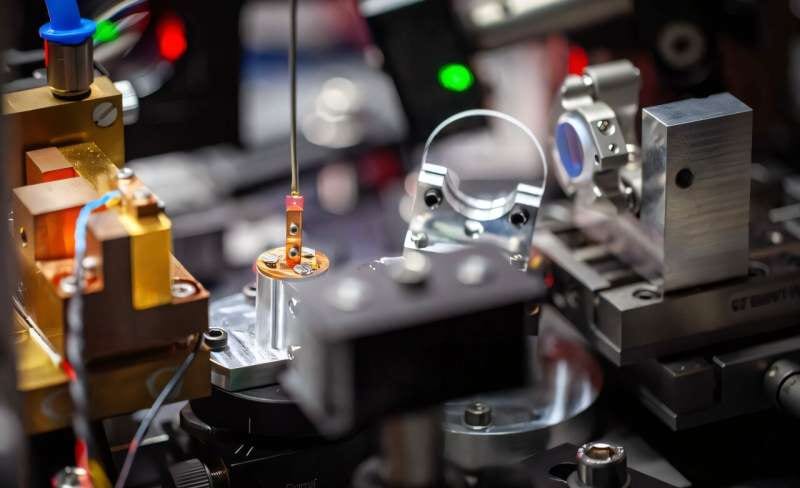
Researchers at Fraunhofer IAF have developed a laser-enhanced quantum sensor that combines high magnetic-field sensitivity with a large dynamic range. Using laser threshold magnetometry, they improved the ratio of sensitivity and dynamic range by a factor of up to 590 compared with state-of-the-art approaches. The breakthrough is enabled by the first demonstration of 100% optical contrast, combined with strong laser readout signals. The results, published in Nature Communications, open up new prospects for medical diagnostics, navigation, and resource exploration.
Magnetic-field sensors based on nitrogen-vacancy (NV) centers in diamond are among the leading solid-state quantum sensors. They operate at room temperature, can be integrated into compact devices and enable vector magnetometry—the measurement of both the magnitude and direction of a magnetic field. Recent advances have improved their sensitivity into the sub-pT/√Hz range, a regime relevant for detecting cardiac signals.
Until now, however, researchers have had to make a trade-off: sensors with very high sensitivity offer only a very limited dynamic range, while more robust variants with a large dynamic range were considerably less sensitive.
To address this limitation, researchers at the Fraunhofer Institute for Applied Solid State Physics IAF are pursuing laser threshold magnetometry, an approach that mitigates this trade-off by combining high sensitivity with a large dynamic range. In this approach, NV centers in diamond are directly integrated into a laser cavity as an optical element, where they act as a magnetic-field-dependent loss channel. Rather than measuring the NV fluorescence, the researchers use the system's laser signal as the readout.
First demonstration of 100% optical contrast
The researchers demonstrate such a two-media laser threshold magnetometer. The strong coupling of the NV centers to the cavity field enhances the sensor's response to changes in the magnetic field. The laser system thus achieves 100% optical contrast, rather than the few percent typical for NV magnetometry. It also delivers a coherent laser readout signal with an output power of up to 50 mW, substantially higher than that of conventional NV-fluorescence readout.
If photon shot noise is the dominant noise source, this combination of high contrast and a strong signal yields a sensitivity below 400 fT/√Hz for each of the three components of the magnetic-field vector. The study also provides the first experimental demonstration that the attainable sensitivity improves more than linearly as optical contrast approaches 100%.
Up to a 590-fold improvement
The ratio of the sensitivity limit to the dynamic range is crucial, since improvements in one typically come at the expense of the other. Compared with conventional fluorescence-based NV sensors and vapor-cell magnetometers, the NV-diamond laser system improves this ratio by up to a factor of 590 while maintaining vector magnetometry capability.
"Our approach could resolve a trade-off that has long limited the development and application of magnetic-field sensors. It could pave the way for a new generation of mobile, highly sensitive magnetic-field sensors," says Florian Schall, first author of the paper and a quantum-sensing researcher at Fraunhofer IAF.
A decade ago, Dr. Jan Jeske, head of the Quantum Sensing Group at Fraunhofer IAF, was the first to develop a theoretical model for a magnetic-field-dependent laser system based on a diamond containing NV centers. "The prospect of substantially improving sensing performance motivated us to pursue laser threshold magnetometry over the long term. I am very pleased that we have now experimentally demonstrated the magnetic-field-dependent shift in the lasing threshold," says Jeske.
Potential applications for these quantum sensors include detecting biomagnetic signals from the heart, muscles and brain; enabling magnetic-field-based navigation; and identifying magnetic anomalies, for example, in resource exploration and security applications.
Publication details
Florian Schall et al., Laser-enhanced quantum sensing boosts sensitivity and dynamic range, Nature Communications (2026). DOI: 10.1038/s41467-026-78386-z
Who's behind this story?

Lisa Lock
BA art history, MA material culture. Former museum editor, paramedic, and transplant coordinator. Editing for Science X since 2021. Full profile →

Robert Egan
Bachelor's in mathematical biology, Master's in creative writing. Well-traveled with unique perspectives on science and language. Full profile →
Citation: Diamond laser system achieves 100% optical contrast in magnetic-field readout (2026, October 22) retrieved 22 October 2026 from https://phys.org/news/2026-10-diamond-laser-optical-contrast-magnetic.html
This document is subject to copyright. Apart from any fair dealing for the purpose of private study or research, no part may be reproduced without the written permission. The content is provided for information purposes only.
Source: Phys.org Optics & Photonics · phys.org