SIOM Makes Breakthrough in Accelerating High-Energy Protons with Transition Radiation Fields
上海光机所在渡越辐射场加速高能质子方面取得重要突破
Topics and contents
The Shanghai Institute of Optics and Fine Mechanics has made a major breakthrough in accelerating high-energy protons using transition radiation fields.
The original article provides specific data and details that help assess actual progress in this direction
Excellent Innovation Brief on Ultra-Intense Laser Science
(Issue 813)
August 19, 2026
Shanghai Institute of Optics and Mechanics Achieves Major Breakthrough in Accelerating High-Energy Protons with Transition Radiation Fields
Recently, a research team from the State Key Laboratory of Ultra-Intensity Laser Science and Technology at the Shanghai Institute of Optics and Fine Mechanics, Chinese Academy of Sciences, achieved a major breakthrough in high-energy proton acceleration using transition radiation fields. The results were published in Nature Communications under the title “Transition Radiation Field Enhanced Laser Proton Acceleration Employing Near-Critical-Density Foam”.
Laser-driven proton sources hold significant promise for novel fusion energy, FLASH cancer therapy, diagnostics of high-energy-density states of matter, laser nuclear physics, and other fields. Over the past nearly three decades, a range of mechanisms have been developed to obtain high-quality proton beams, including target normal sheath acceleration, radiation pressure acceleration, shock acceleration, Coulomb explosion acceleration, and corresponding hybrid schemes. These laser-driven proton acceleration processes fundamentally rely on the plasma's local charge-separation field (Charge-Separation Field, CSF).
The research team used the Shanghai Superintense Ultrafast Laser Facility (SULF, Xiwang Laser) and a 2 PW femtosecond laser to irradiate near-critical-density carbon nanotube foam, carrying out studies of laser-driven high-energy proton beam acceleration. They discovered a new laser proton acceleration mechanism — Transition Radiation Field Acceleration (Transition Radiation Field Acceleration, TRFA). This mechanism accelerates protons using a radiation field, unlike previous schemes based on local charge-separation fields.
In the experiment, femtosecond pulses focused to intensities of up to 1021-1022 W/cm2 propagated through tens of micrometers of near-critical-density carbon nanotube foam, producing a high-charge (30 nC, >13 MeV) relativistic electron beam via direct laser acceleration. As the relativistic electrons crossed the interface between the high-density substrate and vacuum, they generated terahertz-band transition radiation with energy up to 0.6 J. This transition radiation forms a longitudinal accelerating electric field of 1012-1013 V/m at the target's rear surface, comparable in strength to local charge-separation fields and capable of effective proton acceleration. Ultimately, this scheme yielded an experimental proton beam cutoff energy of up to 90 MeV, a twofold increase over the case of a planar target.
This work is the first to clarify how the relativistic electron beam couples energy to the proton acceleration field, elucidating the physical essence of enhanced proton acceleration in near-critical-density targets. It opens a new research direction in laser proton acceleration and is expected to advance laser proton sources toward applications such as proton-boron aneutronic fusion and laser-driven proton therapy.
The co-first authors of the paper are Associate Researcher Qin Chengyu and Associate Researcher Geng Xuesong of the Shanghai Institute of Optics and Fine Mechanics, Chinese Academy of Sciences; the corresponding authors are Researcher Zhang Hui, Researcher Ji Liangliang, and Academician Li Ruxin. This work was supported by the Chinese Academy of Sciences Pioneer B Special Project, the NSFC Basic Science Center, the National Key R&D Program, the CAS Youth Innovation Team for Stable Support of Basic Research, the Shanghai Rising-Star Program, and the China Postdoctoral Science Foundation General Program.
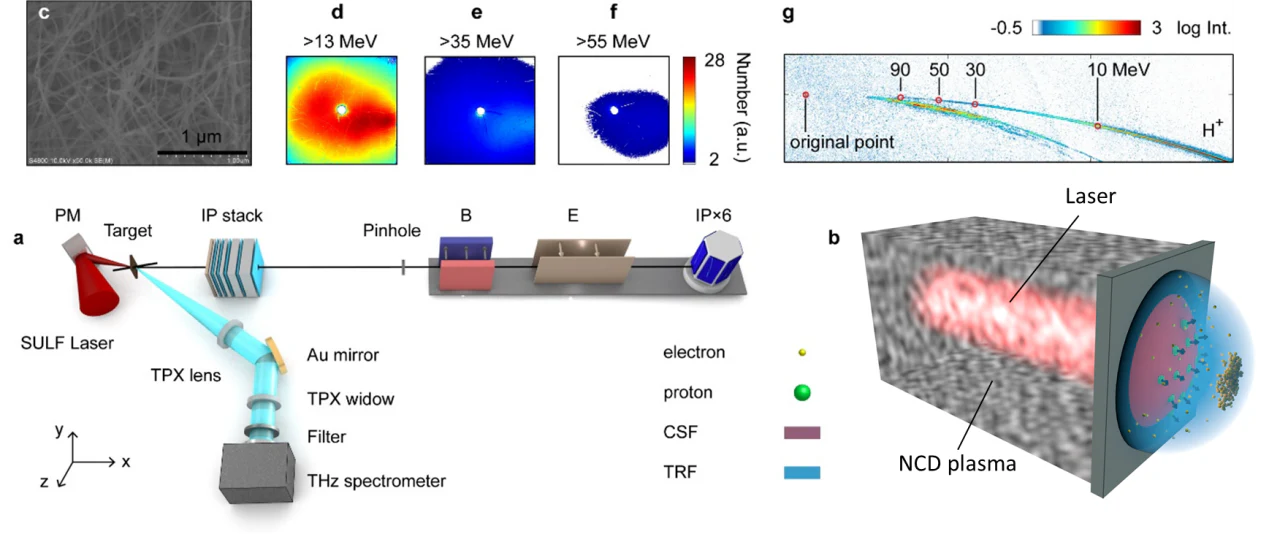
Figure 1: (a) Schematic of the experimental setup; (b) Schematic of the transition radiation field acceleration mechanism; (c) Scanning electron micrograph of the carbon nanotube foam; (d-f) Spatial distribution of the electron beam measured by an electron stack; (g) Raw data from the Thomson spectrometer.
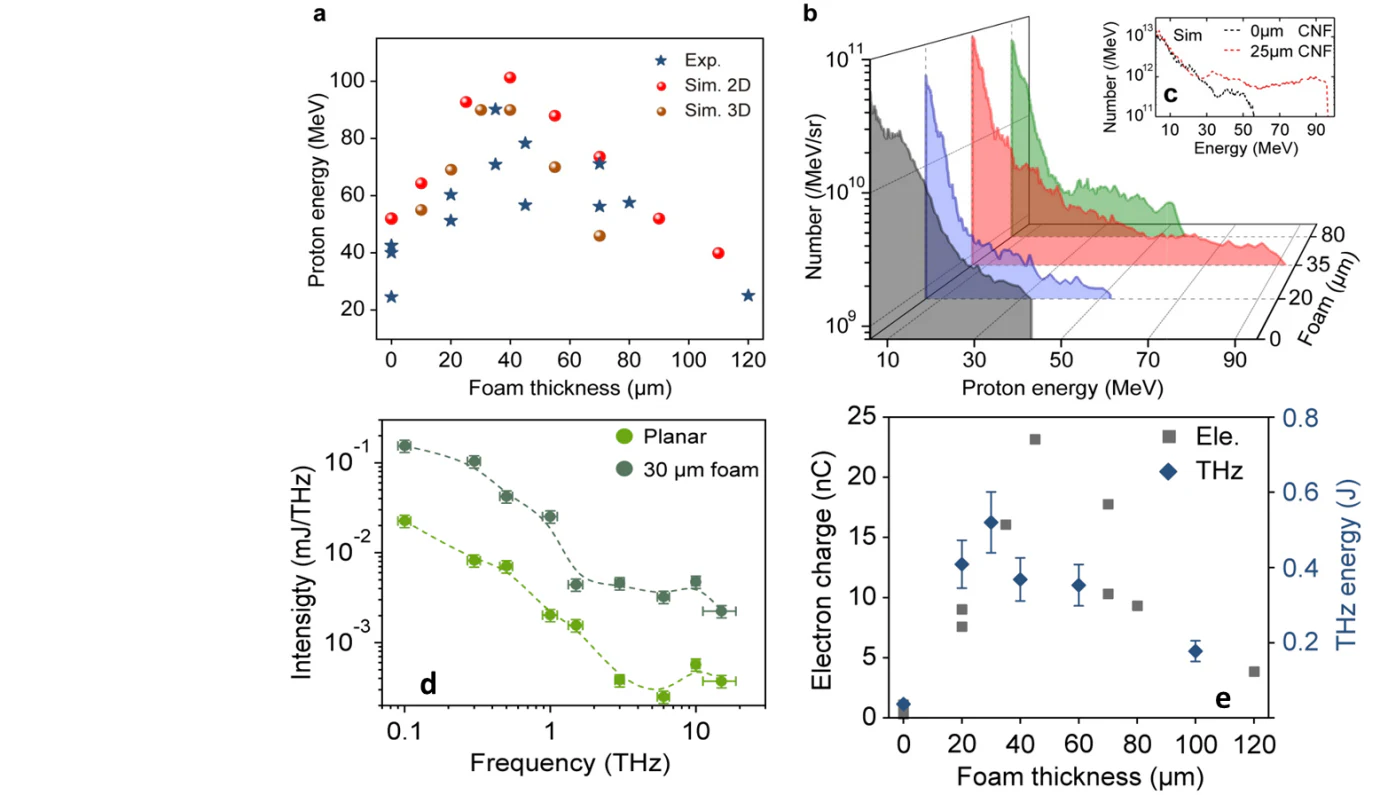
Figure 2: (a) Trend of proton cutoff energy versus foam thickness; (b-c) Experimental and simulated proton energy spectra for different foam thicknesses; (d) Terahertz spectrum generated by transition radiation; (e) Trends of electron charge and terahertz energy versus foam thickness.
Source: Shanghai Institute of Optics and Fine Mechanics (SIOM) · Research Updates · siom.cas.cn