SIOM Achieves Highly Reliable Laser Joining of Titanium Alloy and Nickel-Based Superalloy
上海光机所在钛合金/镍基高温合金异种材料激光连接方面取得新进展
Topics and contents
A team led by Yang Shanglu at the Shanghai Institute of Optics and Fine Mechanics (SIOM) has suppressed brittle intermetallic compounds in laser joining of dissimilar Ti/Ni materials, improving joint reliability.
Excellent Innovation Brief on Ultra-Intense Laser Science
(Issue 825)
September 15, 2026
SIOM Reports New Progress in Laser Joining of Dissimilar Titanium Alloy/Nickel-Based Superalloy Materials
Recently, the team of researcher Yang Shanglu from the Department of High-End Optoelectronic Equipment at the Shanghai Institute of Optics and Fine Mechanics, Chinese Academy of Sciences, made new progress in highly reliable laser joining of dissimilar titanium alloy and nickel-based superalloy materials. To address problems in conventional Ti/Ni dissimilar joints, such as the easy formation of brittle intermetallic compounds, complex interfacial microstructure, and difficult-to-control fracture behavior, the team proposed an ultrafine laser welding method based on spatial configuration control of aCuinterlayer. By adjusting the protrusion height of the Cu interlayer, the method actively controls the spatial distribution of Cu elements during welding, improving the interfacial microstructure and joint fracture behavior. The related findings were published in Journal of Manufacturing Processes under the title “Microstructure and failure behavior of Ti-6Al-4V/Inconel 718 laser-welded joints with protruded-interlayer-induced surface Cu enrichment”.
Ti-6Al-4V titanium alloy offers low density, high specific strength, and excellent corrosion resistance, while Inconel 718 nickel-based superalloy provides good high-temperature strength and oxidation resistance. High-quality joining of the two can meet both lightweight structural and high-temperature service requirements, promising important applications in aerospace, energy and power, and other fields. However, Ti and Ni have poor metallurgical compatibility. During fusion welding, intense interdiffusion of elements and metallurgical reactions readily occur, forming hard and brittle intermetallic compounds that cause interfacial stress concentration and brittle fracture of the joint, making it difficult to improve both the strength and ductility of the joint. Previous studies have mainly controlled interfacial reactions through interlayer material selection and thickness optimization, while the interlayer configuration and geometric dimensions, and their effects on element transport and interfacial microstructure, have yet to be systematically studied.
To address these issues, the research team used a single-mode fiber laser with a spot diameter of just0.04 mmand designed both flush and raisedCuinterlayer configurations. The study found that the raisedCupreferentially melted, collapsed and spread along the weld surface under the laser, forming pronouncedCuenrichment in the near-surface region. This spatial redistribution ofCuin turn altered melt pool flow and interface evolution on theTiside, causing the transition layer to migrate and tilt, thereby achieving synergistic control throughinterlayer geometry—element migration—interface microstructure evolution.
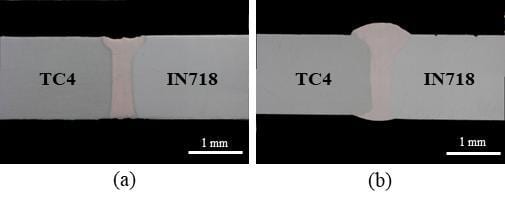
Figure 1Ti/Nilaser-welded joint cross-sectional morphology: (a) flushCuinterlayer (F-Cu); (b) raisedCuinterlayer (P-Cu)
Further investigation showed that surfaceCuenrichment significantly affected the fracture behavior of the joints. Cracks in joints with the flushCuinterlayer propagated mainly along the hard, brittleTi-Cutransition layer, showing distinct quasi-cleavage features. With the raisedCuinterlayer, a relatively wideCu-enriched zone formed on the weld surface; near-surface cracks deflected into the relatively softCu-enriched zone, and dimples appeared on the fracture surface, improving local plastic deformation compatibility. At room temperature, the optimized joint reached a maximum tensile strength of583.9 MPaand a fracture strain of2.05%, increases of about6.4%and66.7%over the548.7 MPaand1.23%of the flush-interlayer joint, respectively. The study also systematically revealed the relationship between thermal softening of theCu-enriched zone and crack path migration at100–300 ℃, providing experimental evidence for understanding intermediate-temperature failure behavior in dissimilar joints.
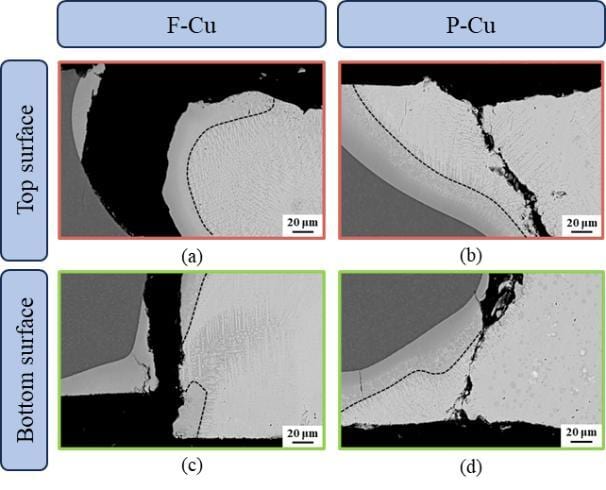
Figure 2 Fracture paths on the upper and lower surfaces of the welded joints (a)F-Cuupper surface; (b)P-Cuupper surface; (c)F-Culower surface; (d)P-Culower surface.
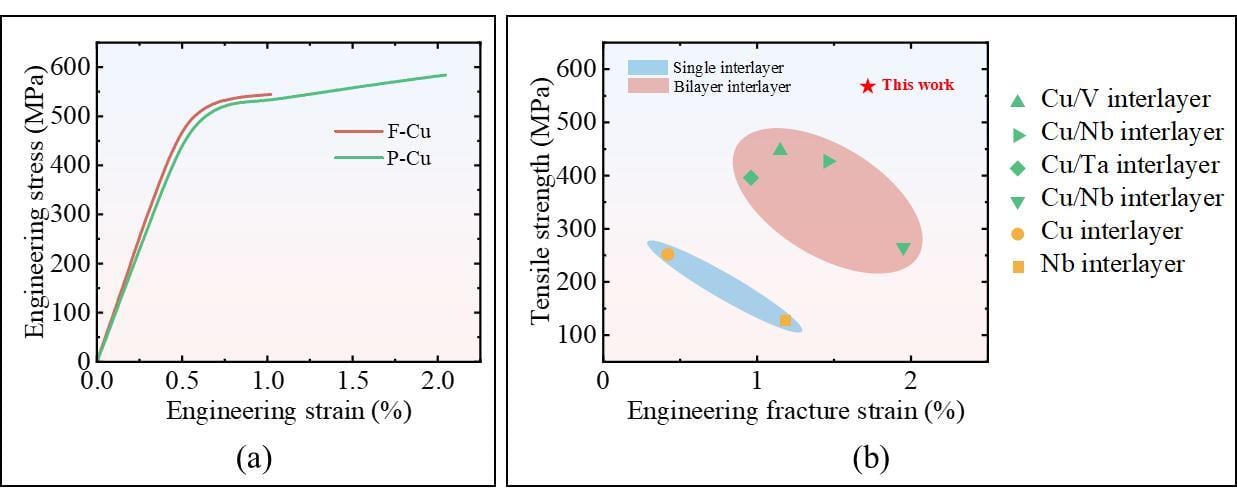
Figure 3 Room-temperature mechanical properties of the joints in this study: (a)engineering stress–strain curves ofF-CuandP-Cuspecimens; (b) comparison of joint tensile strength and fracture strain between this study and previous related studies.
The study breaks with the conventional approach of tuning dissimilar-material interfaces solely through interlayer composition and thickness, proposinga new strategy of adjusting element migration and interfacial reactions via interlayer geometry and configuration. It offers a new technical route for achieving simultaneous strength and ductility gains in dissimilar materials such asTi/Nithat readily form brittle intermetallic compounds, and provides theoretical and technical support for the integrated manufacture of lightweight, high-temperature-resistant dissimilar-material components in aerospace and other fields. The first author of the paper is Yin Qi'an, a doctoral student at the Shanghai Institute of Optics and Fine Mechanics (SIOM), and Researcher Yang Shanglu is the corresponding author. The work was supported by the Shanghai Natural Science Foundation.
Source: Shanghai Institute of Optics and Fine Mechanics (SIOM) · Research Updates · siom.cas.cn