How TDK's Meta-Reflector Retinal Projection Differs from Waveguides and BirdBath
Topics and contents
TDK's AR display solution uses a 150 nm thick meta-optic reflector in place of a conventional curved mirror, forming images through direct retinal projection (DRP). The reflective film has a visible-light transmittance of about 80%, and the current demonstration is still a monochrome prototype. Full-color demonstrations and mass production remain several years away, while consumer-level costs and processing yields are also key hurdles.
By comparing the optical paths of direct retinal projection with those of waveguides and BirdBath, this explains the role of TDK's planar meta-reflector and the constraints on full-color implementation and cost.
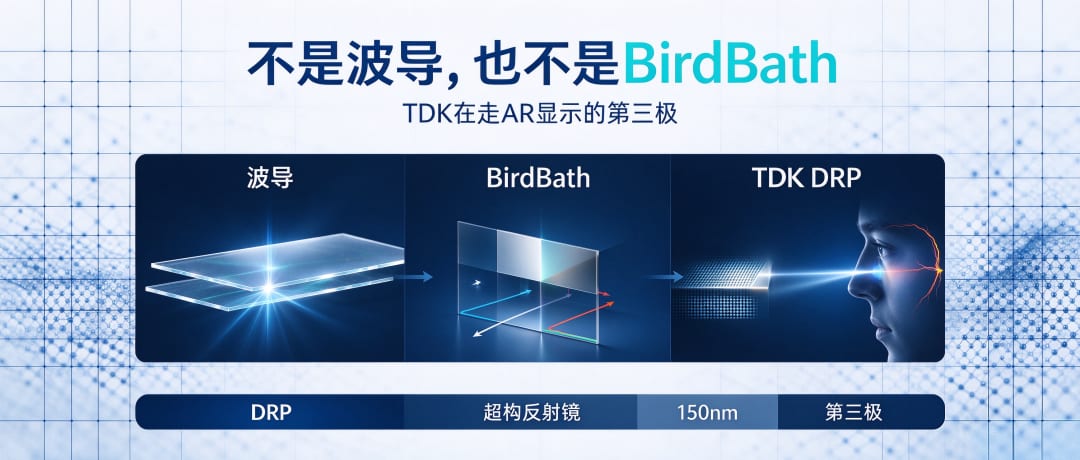
Abstract: TDK's meta-optics mirror solution is neither a waveguide nor a BirdBath variant; it follows the direct retinal projection (DRP) route.
It replaces bulky conventional curved mirrors with 150nm planar nano-mirrors, projecting laser light directly onto the retina. Whether the solution can be commercialized hinges on two major hurdles: full-color capability and consumer-grade cost.
Waveguides have long been regarded by the industry as the "ultimate optical solution" for AR glasses, while BirdBath is the value option for the affordable market.
In October 2026, TDK unveiled a completely new solution: a meta-optical mirror just 150 nanometers thick that can project laser light directly onto the human retina.
It is neither a waveguide nor a BirdBath, and may be opening up a "third pole" for AR displays.
The logic of DRP - not a "screen in front of the eye," but a "projection behind the eye"

To understand what makes TDK's approach unique, it is essential to first distinguish the fundamental difference between direct retinal projection (DRP) and optical waveguides.
The waveguide approach: a virtual image is generated in front of the eye, and the eye must focus on this virtual image plane to see it clearly. The image is positioned in front of the eye.
DRP takes the opposite approach: laser light carrying image information is redirected by optical elements, passes through the pupil into the eyeball, and forms an image directly on the retina using the eye's own refractive system.
The image is not in front of the eye, but behind it. This underlying difference brings several inherent advantages: DRP image clarity is unaffected by the wearer's refractive error, so nearsighted users can see digital images clearly without an additional corrective optical path; prescription lenses may still be needed for viewing the real world, but the digital image does not rely on extra corrective optics.
In theory, it greatly reduces image leakage, making it difficult for bystanders to see what the user is viewing; the laser itself offers high brightness and good color purity, avoiding the light-efficiency losses inherent to optical waveguides.
What did TDK get right? Replacing the "raised curved mirror" with a 150 nm flat mirror
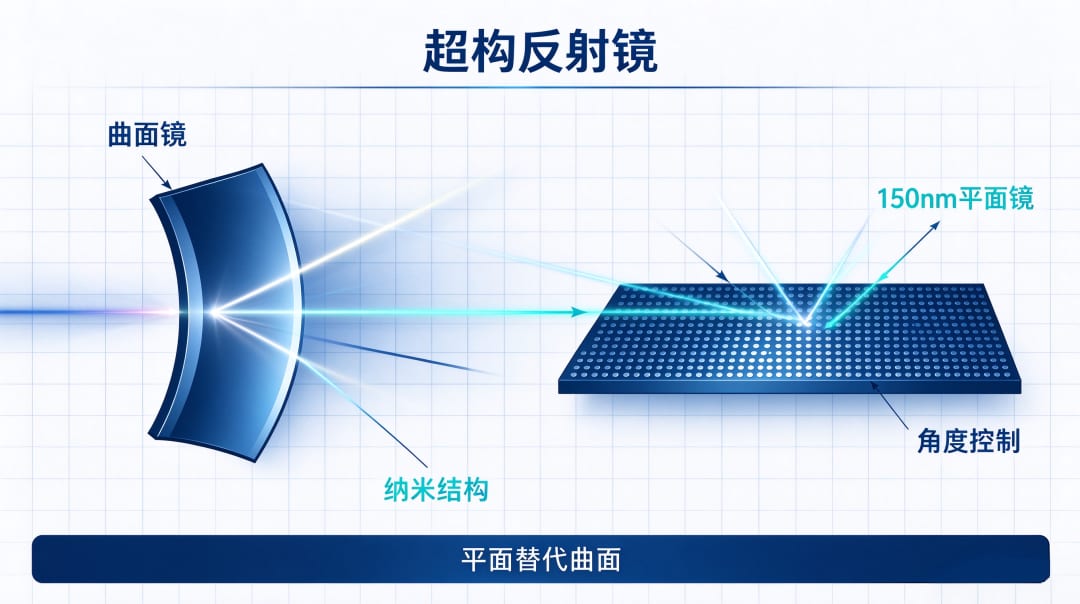
DRP is not an entirely new technology, but it has long had a troublesome drawback: it requires a bulky curved mirror placed in front of the eye to steer the laser beam path.
This outward-bulging mirror makes the glasses look like a science-fiction prop and is hard to turn into eyewear that ordinary people can wear every day. TDK's solution is a meta-optic reflector that replaces the conventional curved mirror.
The reflective film is only 150 nanometers thick, with visible-light transmittance of about 80%.
It uses nanostructures to achieve position-dependent phase and angular response, breaking the fixed relationship of ordinary flat mirrors in which the angle of incidence equals the angle of reflection, and enabling a flat mirror to perform the beam-deflection function of a conventional curved mirror.
Vast numbers of nano-reflective elements are arranged on a flat substrate. The nanostructures at different positions on the mirror change the reflection angle of the light, directing laser beams incident at multiple angles out at the angles required by the DRP optical path.
An ordinary flat mirror strictly follows the rule that the angle of incidence equals the angle of reflection, whereas a meta-reflector uses nanostructures to modulate the phase response of light, achieving light-field control that ordinary flat mirrors cannot.
Put simply, by engineering nanostructures in space instead of shaping curved lens geometry, a flat lens can do the work of a curved one.
Why is it "not a waveguide, and not BirdBath"?
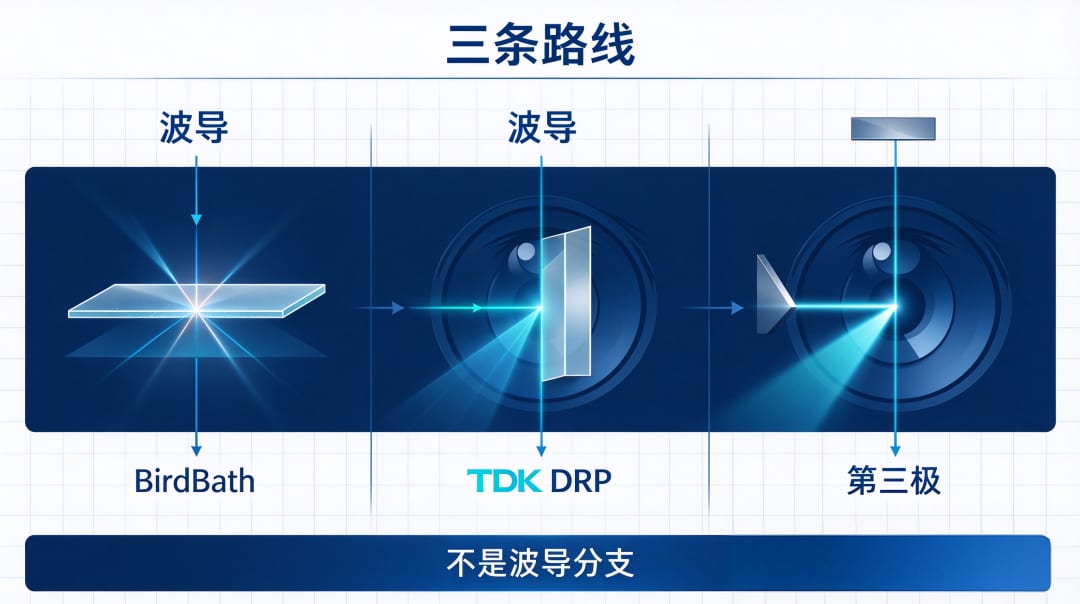
From a technical classification standpoint, TDK's approach is fundamentally different from the two mainstream routes today.
Optical waveguides (geometric / SRG / VHG / metasurface / PVG) share one logic: light propagates inside the waveguide medium by total internal reflection, then exits through a coupling-out structure into the eye, with the light traveling within the waveguide.
The BirdBath approach: the microdisplay outputs the image, which is reflected by a beam splitter into the eye; the light travels through free space plus mirror reflection.
TDK's DRP approach: the laser does not propagate inside a waveguide and does not rely on a beam splitter to divide the light; after its direction is adjusted by a meta-reflector, the light enters the pupil directly, traveling through free space plus metasurface reflection.
Following the classification in the earlier article "Optical Waveguide Technology Classification: Five Routes, Five Physical Logics," geometric, diffractive, metasurface and PVG approaches all fall within the optical waveguide system.
TDK's approach, by contrast, is not a new branch within the waveguide system but a third pole alongside waveguides and BirdBath.
Two hurdles for TDK's approach: full color and cost

What TDK has shown publicly so far is still a monochrome prototype, and the company has stated explicitly that the meta-optic reflector currently supports only monochrome operation, with full-color demonstrations and mass production still several years away.
The difficulty of full color: DRP requires red, green and blue lasers to enter the pupil simultaneously at precisely aligned angles.
Because the three colors have different wavelengths, the meta-reflector must independently control the reflection angle for each of the three wavelengths while maintaining high transmittance and suppressing channel crosstalk.
TDK has developed a compact full-color laser module (FCLM) and a 4K visible-light laser control unit, but these are supporting components and do not mean that this monochrome prototype has achieved full-color imaging.
Cost: TDK notes that metalenses can be fabricated using semiconductor-like processes, opening the prospect of cost-competitive mass production in the future.
But semiconductor-style processes do not automatically mean low cost. Nanostructure overlay alignment, wavelength sensitivity, and large-area uniformity remain major industry pitfalls. Achieving stable, high-yield output from this visible-wavelength nanofabrication process is still a widespread challenge for the metalens optics industry.
What does this mean for the industry? The value of TDK's approach to the AR industry lies not in the performance ceiling of the current prototype, but in offering a completely different physical pathway.
If this route proves viable, AR optics will no longer be limited to just two options: optical waveguides and BirdBath.
Several potential advantages of the metalens reflective DRP: it is not constrained by waveguide light efficiency, nearsighted users can view digital images without corrective optics, and it theoretically greatly reduces image leakage, precisely addressing several major pain points of existing optical waveguides.
But whether this "third path" can hold its ground does not depend on how elegant the principle is. Two things are key: whether a mature full-color solution can be achieved in the next few years, and whether costs can be brought down to a range acceptable for consumer-grade glasses.
In short: worth continued tracking, but this 2026 monochrome prototype is still a long way from a truly mature third path.
Discussion topic: TDK's meta-reflector DRP solution versus optical waveguides - which path do you think will be the first to succeed in consumer AR glasses? Share your take in the comments.
[Risk note] This article is an introduction to the AR industry. Descriptions of TDK's solution are based on public technical disclosures. Prototype performance, full-color development progress, yield rates and mass-production costs remain uncertain. Technology deployment timelines and final product performance are subject to manufacturers' subsequent official announcements.
- AR Andy | Focusing on optical waveguides and AR microdisplays, with in-depth analysis of the underlying logic of the optics industry
Original title : Not Waveguide, Not BirdBath: TDK Takes a "Third Path" for AR Displays
Source: OFweek Optics Network · News · optics.ofweek.com