Ultrafast Laser Controls Cr₂Ge₂Te₆ Ferromagnetism Through Nonthermal Mechanism
Ultrafast light can control ferromagnetism without relying on heating
Topics and contents
A University of Illinois research team used linearly polarized near-infrared ultrafast laser pulses to control the magnetization of Cr₂Ge₂Te₆ (CGT) without relying on heating. The polarization, temperature and optical fluence dependence of the terahertz emission match a nonlinear Edelstein-Zeeman field model, pointing to a magnetization control mechanism mediated by conduction electrons. The results were published in Nature Communications. Magnetization changes are currently read out indirectly via terahertz emission, and the researchers plan to observe their time evolution directly.
Linearly polarized light produces a polarization-dependent terahertz response in a centrosymmetric material, providing a concrete case for understanding how ultrafast optical fields affect magnetization through conduction electrons.
Despite being known for more mundane uses such as sticking notes to refrigerators or keeping bags shut, magnetization is one of the most fundamental and useful properties of a material. Indeed, it forms the physical basis for storing most of our digital information, encoding the bits used in hard drives, computer memories and credit cards.
In a new study published in the journal Nature Communications, Illinois researchers have found a noninvasive way to control magnetization on the order of trillionths of a second in the ferromagnetic semiconductor chromium germanium telluride (Cr₂Ge₂Te₆, or CGT). Their technique uses ultrafast laser pulses to steer CGT's magnetization around in time, taking advantage of an effect that couples its conduction electrons to its magnetic states.
Optical control of magnetization offers advantages
A material's magnetism arises when subatomic "arrows" called magnetic dipoles combine to form a net quantity called the magnetization, which points in the average dipole direction like a macroscopic compass needle. In digital storage media, different magnetization orientations are used to encode information as bits.
Of course, not only must these bits be stored, but they also must be switched in a controlled way, such as when modifying a computer file. A conventional way to change a material's magnetization is to apply an external magnetic field, which can reorient the magnetization much like a compass aligns with Earth's field to point north.
But former Illinois physics graduate student Yinchuan Lv said that these conventional approaches face practical limitations in switching speed, motivating researchers to explore alternatives.
Now a postdoctoral research associate at SLAC National Accelerator Laboratory, Lv explained, "Using light to control magnetization is one of the frontier topics in applied physics today. Ultrafast laser pulses can excite electrons on femtosecond timescales, opening up the possibility of manipulating magnetic states much faster than conventional approaches."
Illinois physics professor Fahad Mahmood noted, however, that despite their speed advantage, "many of these optical techniques rely on heating the material or on specific requirements, such as using circularly polarized light."
Plus, light's electric field primarily interacts with a material's electrons through their charge rather than directly with the material's magnetization. In certain materials such as CGT, however, spin-orbit interactions—which link an electron's intrinsic magnetic dipole, or spin, to its orbital motion—provide a pathway for light to influence magnetic order effectively.
Illinois physics postdoctoral research associate Joe Meese described, "CGT's magnetization is particularly sensitive to perturbations and displays strong spin-orbit coupling. Some experiments have shown that one can detect CGT's magnetic behaviors with circularly polarized light, with hints that nonthermal optical processes are at play."
However, CGT is centrosymmetric, meaning that its atoms are symmetrically arranged around a common center point. This symmetry forbids certain types of direct coupling between light's electric field and magnetization, making it challenging to control magnetization using linearly polarized light.
Nevertheless, spin-orbit interactions remain present in CGT, opening the door to alternative mechanisms through which light can influence its magnetism.
Strong signals suggest an unexpected mechanism
To investigate whether light could control magnetization despite the restrictions imposed by centrosymmetry, Mahmood's team turned to emission spectroscopy. The basic idea is simple: blast a material with laser pulses, then look at the light the material emits in response.
Lv, the lead experimentalist and a former student of Mahmood, remarked, "We've used this technique to study a bunch of magnetic materials, and CGT was actually one we didn't expect to see a big signal from because it's centrosymmetric. It turns out, however, that it has a pretty large response—something totally unexpected."
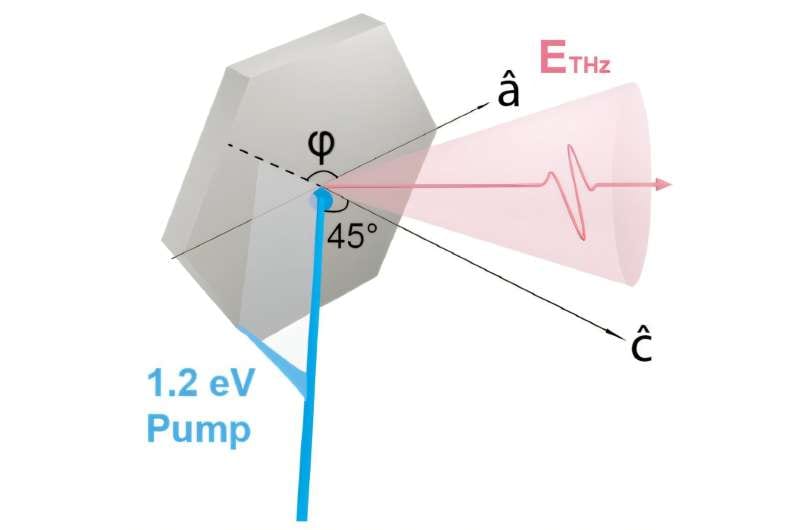
In fact, when they shot their CGT sample with linearly polarized, near-infrared (NIR) laser pulses, the sample emitted light in the terahertz (THz) frequency range. The THz signal also varied depending on the incoming NIR beam's polarization angle, fluence (intensity averaged over time) and sample temperature.
Mahmood commented, "What surprised us was the strength and very specific polarization dependence of this signal. The polarization pattern immediately suggested something unconventional was occurring."
If, for instance, the NIR light was shot directly onto the sample head-on, the THz emission signal exhibited a four-petal, flower-shaped pattern as the polarization angle was changed. This pattern persisted across different sample temperatures and light fluences. And if the NIR light was shot at a tilted angle instead, the four petals reduced to two, and the pattern exhibited an unusual dependence on fluence.
This polarization dependence hinted that CGT's magnetization was very likely the source of the THz emission. Another measurement especially stood out: Rather than observing a strong magnetic signal in CGT's low-temperature, magnetically ordered phase and a zero signal in its high-temperature, magnetically disordered phase, they saw the opposite.
The signal increased when the researchers raised the sample temperature! In fact, the signal rose even when the sample's temperature exceeded its so-called Curie temperature, above which CGT loses its magnetism altogether.
"The fact that CGT's behavior was again the opposite of our expectations is what got all of our attention," Meese said.
Light interacts with magnetization through the nonlinear Edelstein effect
The researchers suspected that the NIR light's electric field was changing the magnetization in time, making it radiate its own light as a consequence of classical electromagnetism. But how was the electric field changing the magnetization in the first place?
Mahmood recalled, "We first considered several possibilities, including laser-induced demagnetization and other optically induced mechanisms."
They realized the most likely culprit was the nonlinear Edelstein effect, a phenomenon that enables electric fields and magnetization to couple together even in centrosymmetric materials with linearly polarized light. CGT's conduction electrons were also playing an essential role.
Semiconductors like CGT insulate because their electrons are stuck in a range of low-energy states. But given some input energy, such as laser light at the right frequency, the electrons jump to higher-energy states where electrons move about and conduct electricity.
They reasoned that, once the laser light pushes the electrons into these conducting states, spin-orbit interactions effectively generate their own magnetic field through the nonlinear Edelstein effect—known as the Edelstein-Zeeman field—which can then magnetize CGT.
As Meese summarized, "The electrons we excite with the light are initially only very weakly coupled to the ferromagnetic states. The nonlinear Edelstein effect arises when the conduction states evade spin-orbit cancellation normally required by centrosymmetric crystals in equilibrium.
"It's this Edelstein-Zeeman field caused by the conduction electrons that the ferromagnetic states ultimately feel. The effect on the magnetism is essentially a static field generated by this very dynamic light."
Inspired by this line of reasoning, the researchers applied the nonlinear Edelstein effect's equations to CGT, showing that light's electric field gives rise to magnetization in theory. In particular, they showed that light's polarization angle and fluence can be adjusted to enhance certain magnetization components, just as their data indicated. The equations even reproduced the flower pattern they observed in their experiment!
Model explains magnetization's dependence on temperature and fluence
To account for these new observations, the researchers modeled their system, deriving a formula for a quantity called the free energy. Their model showed that adjusting both sample temperature and beam fluence molds the free energy, creating pockets into which the magnetization can "fall," just like a ball in a hilly landscape finds a stable valley to settle in. Depending on the locations and shapes of the pockets, the magnetization acquires different strengths and orientations.
Additionally, simulating the model enabled the team to make numerical predictions of different magnetization orientations as functions of temperature and fluence.
Remarkably, the model precisely matched up with their data in both the head-on and tilted-angle experiments—strong evidence that the nonlinear Edelstein effect indeed links CGT's conduction electrons to its magnetic states when shot with NIR light, just as they theorized.
Testing other materials and visualizing magnetization dynamics
This discovery adds a new tool for ultrafast magnetic control. The emission in the THz range indicates that the magnetization is switching at an extremely fast timescale of trillionths of a second, a method no one thought possible in a material like CGT. Crucially, this method does not change the temperature of the sample, a goal that has consistently eluded scientists and engineers.
Mahmood stressed, "The significance is not only the speed, but also the mechanism and range of materials in which this control may be possible."
In fact, now that the underlying mechanism has been uncovered, the researchers believe this technique will work in other materials besides CGT, including magnets whose dipoles orient themselves differently from ferromagnets. They also hope to directly monitor the magnetization's time evolution.
"We've read off the magnetization based solely on this terahertz emission," Lv acknowledged. "To get a more concrete understanding, future experiments may include actually visualizing the magnetization dynamics directly."
Publication details
Yinchuan Lv et al., Manipulation of ferromagnetism with a light-driven nonlinear Edelstein-Zeeman field, Nature Communications (2026). DOI: 10.1038/s41467-026-77965-4
Who's behind this story?

Sadie Harley
BSc Life Sciences & Ecology. Microbiology lab background with pharmaceutical news experience in oil, gas, and renewable industries. Full profile →

Robert Egan
Bachelor's in mathematical biology, Master's in creative writing. Well-traveled with unique perspectives on science and language. Full profile →
Citation: Ultrafast light can control ferromagnetism without relying on heating (2026, October 21) retrieved 21 October 2026 from https://phys.org/news/2026-10-ultrafast-ferromagnetism.html
This document is subject to copyright. Apart from any fair dealing for the purpose of private study or research, no part may be reproduced without the written permission. The content is provided for information purposes only.
Source: Phys.org Optics & Photonics · phys.org