LCLS Measures Hard X-Ray Pulses of About 9 keV and 100 to 400 Attoseconds
X-ray free-electron laser sets new record for shortest high-energy pulses
Topics and contents
A research team at SLAC's LCLS measured hard X-ray pulses with photon energies of about 9 keV and durations of 100 to 400 attoseconds, with results published in Nature Photonics. The team focused part of the beam to a 150 nm wide spot on a copper foil to generate amplified spontaneous emission, then combined the energy and spectral shape of the other part of the beam to calculate the pulse duration. Such pulses can be used to probe rapid processes in dense plasmas and to help make measurements before X-rays cause electronic-state damage.
By inferring pulse duration from amplified spontaneous emission in a copper foil, this work links the high energy of hard X-rays to an attosecond time scale through a measurable experimental diagnostic.
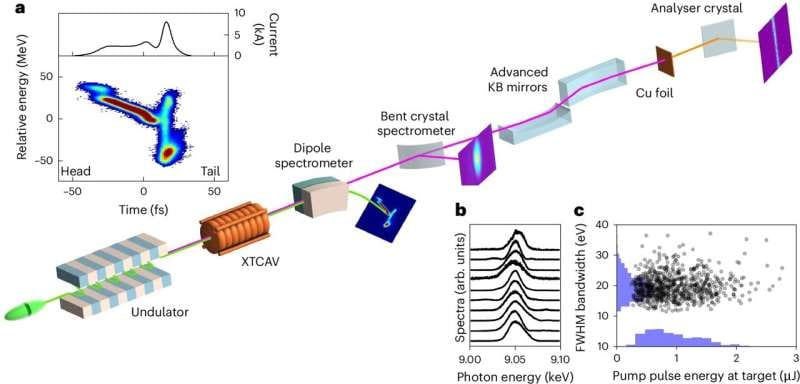
Researchers at the Linac Coherent Light Source (LCLS) at the U.S. Department of Energy's SLAC National Accelerator Laboratory have measured the shortest high-energy X-ray pulses ever recorded at an X-ray free-electron laser (XFEL). The pulses had photon energies of about 9 kiloelectronvolts (keV) and clocked in at durations of 100 to 400 attoseconds—mere billionths of a billionth of a second. The results are published in Nature Photonics.
These high-energy, or "hard," attosecond X-ray pulses are invaluable for researchers studying the universe at its smallest, fastest scales. "The pulses are both energetic enough to look deep into atomic systems and fast enough to record electronic motion frozen in time," said Agostino Marinelli, a study author and professor of photon science, particle physics and astrophysics at SLAC.
The challenge, Marinelli explained, wasn't creating these ultrashort pulses, but rather proving that it had been done. "Over the course of several years, we've learned how to create these high-energy attosecond pulses, but measuring pulses this short is really, really difficult. This was the first diagnostic that proves the pulses are indeed only a few hundred attoseconds long."
The study's lead author, Ichiro Inoue, professor at the University of Tokyo, proposed using amplified spontaneous emission (ASE) to indirectly measure the duration of LCLS pulses. ASE is an effect that occurs when intensely focused X-ray pulses excite a specific element, causing it to fluoresce in a forward direction. Embedded in that fluorescence is information about the original X-ray pulse's energy, shape and duration.
The team used LCLS to generate a high-energy beam of what they believed to be attosecond X-rays. They diverted part of the beam to a detector that measured its energy and the shape of its spectrum. The rest of the beam was focused to a spot just 150 nanometers wide on a copper foil, generating ASE that was captured by another detector. By combining these measurements, the team was able to calculate the pulse's duration.
"This is an important milestone for researchers who want to use attosecond hard X-rays at LCLS," said Inoue. This study comes as the international research community has expressed eagerness to use these pulses in their research, allowing them to peer more deeply into atoms and dense systems and even outrun damage incurred by the X-rays themselves.
A deeper look at atomic systems
In 2019, a team led by Marinelli generated attosecond X-rays in the low-energy, or "soft," X-ray regime (below 5 keV). Soft X-rays are ideal for measuring electron energy, which allows researchers to study electron movement in chemical bonds and atoms' outer shells. Scientists use these pulses to study things like real-time electron movement in water.
High-energy X-rays (above 5 keV), on the other hand, penetrate deeper into materials and can be used to capture images with enough resolution to pinpoint the location of electrons with atomic-scale accuracy.
By demonstrating that LCLS can deliver high-energy attosecond X-rays, the team has opened attosecond science to a new user base, including researchers like Sam Vinko, professor of physics at the University of Oxford, who studies plasmas—the hot, dense matter found in stars and inertial fusion energy experiments, where higher-energy X-rays are needed to probe conditions beyond the reach of soft X-rays. Until now, X-rays were either not energetic enough to penetrate these dense plasmas or not fast enough to capture their fleeting core-excited states.
"Plasma physics is very messy," Vinko said. "Normally, we excite our sample, then the system relaxes and recombines before we can extract a measurement. We're often forced to rely on modeling and make assumptions about what exactly is happening."
This spring at LCLS, he finally had X-ray pulses energetic enough to penetrate and fast enough to freeze the dense plasma before its own dynamics could blur the picture—a first at any XFEL. "For the first time, we could measure these core-excited states before they had time to evolve," Vinko said. "For a plasma physicist, that's just amazing."
Outrunning X-ray damage
Attosecond hard X-rays offer another benefit: They outrun X-ray-induced damage.
"X-ray pulses themselves cause damage to electronic states of matter, but with attosecond pulses, we can capture the electronic state in its pristine state, essentially outrunning the damage," Inoue said.
Researchers like Tais Gorkhover, head of the advanced ultrafast X-ray imaging group at the University of Hamburg, plan to use these pulses to sharpen nanoscale images made by absorption and scattering. She successfully used attosecond soft X-rays at LCLS for diffraction imaging and to identify ways to improve spatial resolution, and she believes that attosecond hard X-rays could have an even stronger effect.
"There's a lot of excitement that, with attosecond pulses, you get extremely high temporal resolution, where you can truly disentangle nuclear and electronic dynamics," Gorkhover said.
Gorkhover also sees a path to actively control how matter interacts with light—and perhaps even reverse X-ray damage mechanisms. "If we look beyond even time resolution, we can see attosecond pulses as a new tool to control light-matter interaction in ways researchers have only fantasized about," Gorkhover said.
Publication details
Ichiro Inoue et al., Experimental demonstration of attosecond hard X-ray pulses, Nature Photonics (2026). DOI: 10.1038/s41566-026-02026-7
Who's behind this story?

Gaby Clark
MA in English, copy editor since 2021 with experience in higher education and health content. Dedicated to trustworthy science news. Full profile →

Robert Egan
Bachelor's in mathematical biology, Master's in creative writing. Well-traveled with unique perspectives on science and language. Full profile →
Citation: X-ray free-electron laser sets new record for shortest high-energy pulses (2026, October 21) retrieved 21 October 2026 from https://phys.org/news/2026-10-ray-free-electron-laser-shortest.html
This document is subject to copyright. Apart from any fair dealing for the purpose of private study or research, no part may be reproduced without the written permission. The content is provided for information purposes only.
Source: Phys.org Optics & Photonics · phys.org