SeeYA Technology Q3 2026 Revenue Up 409% Year on Year, Turning a Quarterly Profit
Topics and contents
Topic
On this page
SeeYA Technology reported third-quarter revenue of 724 million yuan, up 409.00% year on year, with net profit attributable to shareholders of 84.7932 million yuan, turning a profit for the quarter. Revenue for the first three quarters was 1.308 billion yuan, with net profit attributable to shareholders of 31.0712 million yuan. The company attributed the revenue growth to increased customer demand and shipments. The original article notes that demand for silicon-based OLED should focus on AR/ER and MR devices, while sustained profitability is also affected by customer concentration and Micro-LED technology iteration.
Quarterly profitability and end-product category demand are discussed within the same framework, providing concrete context for distinguishing silicon-based OLED mass production windows, customer concentration risk and market statistical definitions.
On October 21, SeeYA Technology released its Q3 2026 report. Revenue for the first three quarters reached 1.308 billion yuan, up 346.73% year on year; net profit attributable to shareholders of the parent company was 31.0712 million yuan, turning a year-earlier loss into a profit; net profit excluding non-recurring items was 21.9276 million yuan.
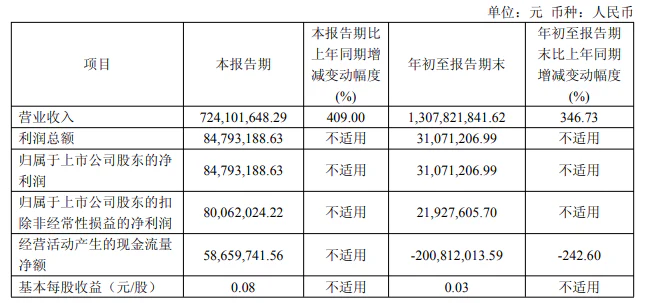
Q3 revenue alone reached 724 million yuan, up 409.00% year on year; net profit attributable to shareholders of the parent company was 84.7932 million yuan, and net profit excluding non-recurring items was 80.062 million yuan. Quarterly earnings have already covered the first-half loss. Gross margin for the first three quarters was 26.77%, and net operating cash flow for Q3 was 58.6597 million yuan. This suggests that silicon-based OLED microdisplays are entering a validation phase for operating leverage.
The company said the sharp revenue increase was mainly driven by higher customer demand and a substantial rise in shipments during the reporting period.
Placing SeeYA's quarterly report in an industry context makes the signal clearer. IDC forecasts that global shipments of domestic AI glasses in 2026, measured by Chinese vendors' worldwide shipments, will reach about 22.671 million units, up 56.3% year on year. Of these, shipments in the Chinese market are expected to total 4.508 million units, up 77.7%, with growth concentrated in audio glasses, audio-and-camera glasses, and AR/ER glasses.
One caveat is needed: audio and audio-and-camera glasses do not necessarily use silicon-based OLEDs. The real direct driver of silicon-based OLED demand is AR/ER and MR devices, whose share of the above total is lower than the headline figure might suggest. End-market volume growth will pull up demand for upstream microdisplays, but the elasticity should be estimated within the AR/ER and MR categories.
QYResearch data on a narrow definition show that global silicon-based OLED sales were about USD 649 million in 2025 and are expected to reach USD 5.305 billion by 2032, with a CAGR of about 35.0% from 2026 to 2032 - a typical niche segment with a modest total but a steep growth curve.
The more critical variable is the technology window. CIOE 2026's industry overview concludes that although full-color Micro-LED samples have appeared in numbers, most remain engineering samples, while silicon-based OLED is currently the most production-ready display technology and the most likely to absorb the first wave of large-scale AR shipments. SeeYA's earnings surge is the financial confirmation of this
But improved finances do not mean competitive moats are already set. The competitive landscape is shifting rapidly, so describing the current situation with static market shares requires particular caution. Under the Frost & Sullivan methodology, Sony accounted for about 50.8% of global XR-device micro OLED shipments in 2024, and SeeYA about 35.2%, with the two together covering 86%. Omdia data, however, show that by 2026 SeeYA's share of the global micro OLED market had risen to 61.2%, Sony had fallen to 25.9%, and BOE stood at 3.4%. The two data sets use different methodologies and years and cannot be spliced together directly; what they jointly indicate is a directional judgment rather than a quantifiable leap: SeeYA's share moved upward in direction over two years, but part of that may stem from a methodology effect as the statistical scope switched from "XR device shipments" to the "global micro OLED market," rather than representing a genuine shift in competitive position.
At the same time, its reliance on a small number of strategic customers and related-party transaction channels is deepening. Related-party transactions of 1.6 billion yuan accounted for 311.87% of the total for the same type of business in 2025, meaning that revenue is highly tied for the foreseeable future to the closed-loop channel of "specific customers - GoerTek - SeeYA." The resilience of this channel affects earnings sustainability no less than the long-term substitution threat from Micro-LED. Micro-LED's theoretical advantages in brightness and power consumption have not disappeared; once yield and cost curves accelerate downward, the first-mover window for silicon-based OLED will face repricing.
Overall, the core message of SeeYA Technology's Q3 report is that the competitive focus in silicon-based OLEDs is shifting from "who can achieve mass production" to "who can mass-produce with sustainable gross margins." The return to profit in a single quarter validates the reality of demand and the presence of operating leverage, but whether that one-quarter profit can be turned into steady-state profitability that withstands customer concentration and technology iteration cycles is the more important question to track before 2027.
Source: OFweek Optics Network · News · optics.ofweek.com