Programmable Photonic Chip Offers New Way to Probe Topological Properties of Optical Systems
A new way to detect stabilizing properties of optical devices
Topics and contents
A research team at KTH Royal Institute of Technology has demonstrated a programmable photonic chip that can emulate dissipative systems and detect and measure their topological properties. The work uses a mathematical method to simulate loss without actually losing the signal, then compares the light with a reference beam to distinguish topological scenarios from ordinary ones and detect exceptional points. The results were published in Physical Review Letters, and the same chip can be reprogrammed to test different scenarios.
The study reads out topological information in dissipative systems through reference-beam interference and tests different scenarios on the same programmable chip, providing a method for investigating robust properties under loss conditions.
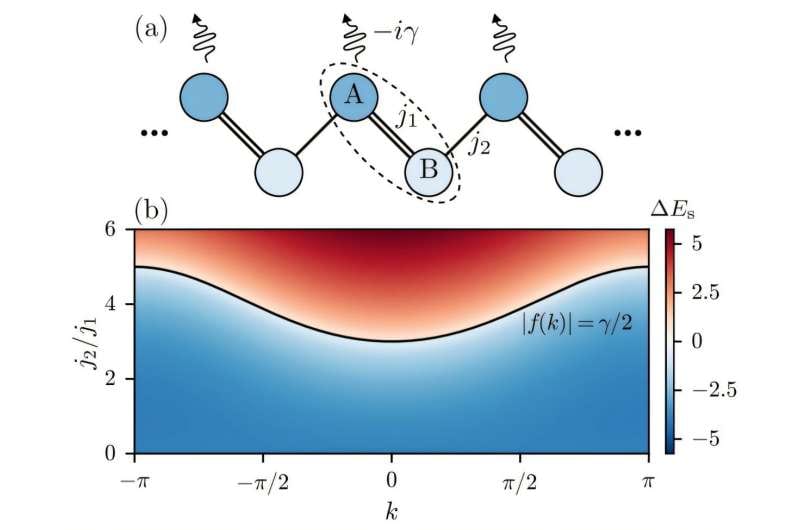
In optical fibers, chips and other light-guiding devices, minor defects can scatter photons and disrupt their path. A new study demonstrates a way to reveal properties which, in certain systems, help light wave behavior withstand such flaws. The method could help speed up the search for new kinds of electronics and optical technologies, and contribute to more reliable quantum devices.
Reporting in Physical Review Letters, researchers at KTH Royal Institute of Technology demonstrate a programmable chip that can detect and measure "topological properties," or features of wave behavior that don't change even when a system is altered.
KTH Associate Professor Ali Elshaari says understanding these properties can help devices keep working despite imperfections.
Topological properties can make materials unusually stable, Elshaari says. "When I explain topology to students, I start with a knot in a rope," he says. "You can stretch it, twist it or shake it, but the knot stays until you cut the rope.
"Physicists have found that some materials and devices carry similar knots in how waves move through them."
KTH doctoral student Andrea Cataldo, the study's lead author, says that kind of stability is attractive for technologies that must work despite noise and defects, such as future electronics and quantum devices.
"In the real world, every system loses some energy," Cataldo says. "So we need ways to study these properties under realistic conditions."
The light-based chip can imitate energy-losing systems and directly reveal their hidden stable properties, he says.
The chip reliably distinguished the "knotted" (topological) cases from ordinary ones, Cataldo says. It also detected a special point where energy-losing systems behave in unusual ways, called an exceptional point.
"We use a mathematical trick to run the lossy system on the chip without actually losing the signal," he says. The researchers then compare the light against reference beams—an approach they compare to tuning an instrument against a reference note.
"This lets us read the hidden information even when energy loss would normally hide it," he says.
Because the chip can be reprogrammed, many different scenarios can be tested on one device.
Publication details
Andrea Cataldo et al. Interferometric readout of momentum-space topology in a programmable dissipative photonic circuit, Physical Review Letters (2026). DOI: 10.1103/xkht-64kc On arXiv DOI: 10.48550/arxiv.2609.38352
Who's behind this story?

Sadie Harley
BSc Life Sciences & Ecology. Microbiology lab background with pharmaceutical news experience in oil, gas, and renewable industries. Full profile →

Robert Egan
Bachelor's in mathematical biology, Master's in creative writing. Well-traveled with unique perspectives on science and language. Full profile →
Citation: A new way to detect stabilizing properties of optical devices (2026, October 18) retrieved 18 October 2026 from https://phys.org/news/2026-10-stabilizing-properties-optical-devices.html
This document is subject to copyright. Apart from any fair dealing for the purpose of private study or research, no part may be reproduced without the written permission. The content is provided for information purposes only.
Source: Phys.org Optics & Photonics · phys.org