Optics Weekly · Week 41, 2026 · Oct 4–10
opticsnews
Silicon Photonics Standard Lands as Optical Module Demand Surges
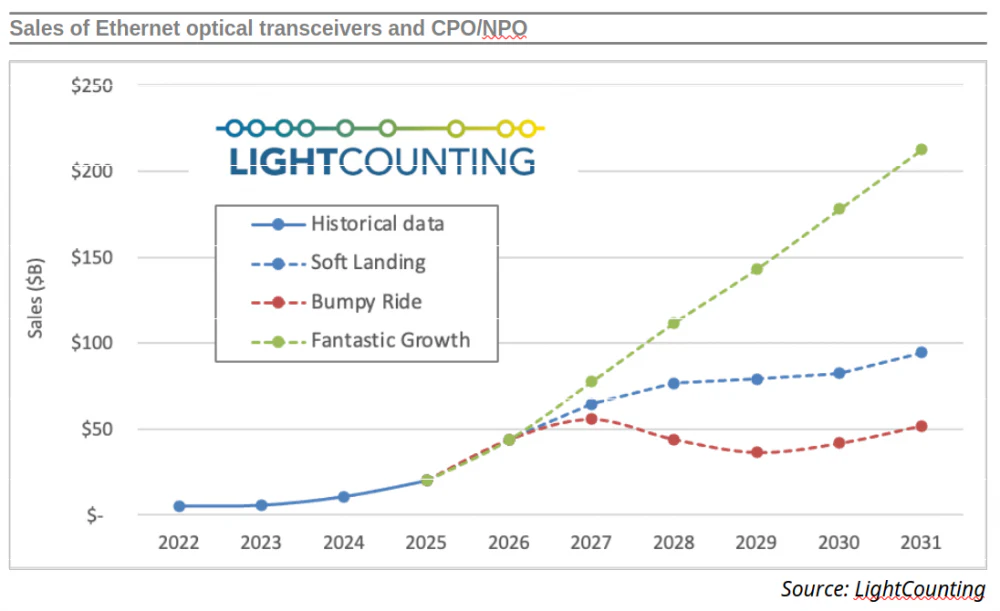
This issue covers October 4 to October 10, 2026. JEDEC released JESD264, the first reliability standard for silicon photonics AI networks; LightCounting expects the Ethernet optical module market to grow 120% in 2026; Lumentum says its 2029 capacity is almost fully booked; Zhishang Technology received a $500 million fiber optic connector demand forecast, as optical interconnect demand spreads to upstream components. Optogenetics received the 2026 Nobel Prize in Physiology or Medicine. On the research side, levitated nanospheres entangling with light at room temperature, chip-scale frequency combs and all-optical metasurface control were published in succession; smart glasses, meanwhile, hit regulatory restrictions in multiple countries.
Optical Module Demand Exceeds Expectations
In this sectionLightCounting expects Ethernet optical module sales to grow 120% this year; Lumentum still cannot meet about 70% of demand for some products next year; Zhishang Technology secures a $500 million connector demand forecast from a PH customer.
LightCounting: Ethernet optical module market forecast to grow 120% in 2026
LightCounting's latest report says growth in the Ethernet optical module market was originally expected to slow in 2026, but data from the first nine months defied expectations: cloud provider capital expenditures accelerated sharply from late January to early February and remained strong over the following six months. The full-year Ethernet optical module market is now forecast to grow 120%.
Lumentum CEO: 2029 Capacity Almost Fully Booked
Lumentum CEO Michael Hurlston said in an interview in Tokyo that about 70% of demand for some products will remain unmet next year, while other products still face a 30% demand gap through 2028. The company's 2029 capacity is almost fully booked, and it is ramping production at full speed.
Zhishang Technology Receives $500 Million Fiber Optic Connector Demand Forecast from PH Customer for 2027
Shenzhen Zhishang Technology announced the signing of a 2027 Demand Forecast Cooperation Memorandum with customer PH. The customer expects to purchase MPO fiber optic patch cords and other fiber optic connectors from the company in 2027, with a forecast target value of $500 million (approximately 3.346 billion yuan). C114 believes optical interconnect demand has expanded from optical modules and optical fiber cables to upstream optical components.
 OFweek Laser Network · NewsOptics industryOptics and AIOct 8
Lumentum Capacity Under Strain: What Businesses Beyond EML and CW Lasers Drive Its Strength
An article by Haitun Jun continues the breakdown of Lumentum: EML secures the core profit base of pluggable optical transceivers, while high-power discrete lasers, UHP CW, bet on next-generation CPO/NPO architectures. With supply and demand severely mismatched for high-end laser chips, leading manufacturers with in-house capacity simultaneously benefit from price increases, long-term orders and rising gross margins.
Silicon Photonics and CPO Progress
In this sectionJEDEC issues JESD264, setting reliability requirements for silicon photonics AI networks; interest in MicroLED co-packaged optics is surging, though technical challenges remain.
JEDEC Releases First Silicon Photonics AI Network Reliability Standard, JESD264
JEDEC has released the JESD264 standard, setting new certification and reliability requirements for the emerging silicon photonics market. It is the first reliability standard for silicon photonics in AI networks.
 Laser Focus WorldOptics industryOptics and AIOct 8
From Pixels to Optical Links: MicroLED Shifts to Co-Packaged Optics
A Laser Focus World article analyzes the surge in industry interest in MicroLED co-packaged optics (CPO) solutions, reflecting their multiple advantages, although technical challenges remain to be resolved.
Quantum and Precision Optics
In this sectionLevitated glass nanospheres entangle with light at room temperature; chip-scale frequency combs show promise for portable atomic clocks; integrated optical cavities could shrink quantum sensors to handheld size; structured light switches magnetic information without a magnetic field.
 Phys.org Optics & PhotonicsOptics industryOct 8
Levitated glass nanosphere entangled with light at room temperature
A paper in Science reports that researchers entangled a levitated glass nanosphere with an optical field in an optical trap, achieving the effect at room temperature and providing a new platform for macroscopic quantum mechanics research.
Phys.org Optics & PhotonicsOptics industryOct 7New chip-scale frequency comb demonstrates potential for portable atomic clocks
Researchers have demonstrated a new chip-scale optical frequency comb formation process in which two laser beams interact, enabling a range of precision measurements and showing potential for use in portable atomic clocks.
 Photonics.comOptics industryOct 7
Infleqtion, Honeywell and UCSB Develop Integrated Optical Cavity to Shrink Quantum Sensors to Handheld Size
Infleqtion, in collaboration with Honeywell Aerospace and the University of California, Santa Barbara, has developed an integrated optical cavity that could help shrink quantum sensors to handheld size.
 Optics & Photonics NewsOptics industryOct 7
UC San Diego switches magnetic information in materials with structured light
Engineers at the University of California, San Diego demonstrated a new method for switching magnetic information in a material using specially designed ultrafast laser beams, without an external magnetic field.
Optical Imaging and AI
In this sectionUCLA's digital-optical hybrid processor identifies multiple deepfake videos in parallel; SF-PULSE lensless imaging monitors live cells without staining; frequency combs plus deep learning enable fast ghost imaging.
Optics & Photonics NewsOptics industryOptics and AIOct 5UCLA digital-optical hybrid processor identifies multiple deepfake videos simultaneously
The Ozcan laboratory at the University of California, Los Angeles developed a digital-optical hybrid system capable of identifying deepfake videos simultaneously across multiple channels.
Phys.org Optics & PhotonicsOptics industryOptics and AIOct 9SF-PULSE Lensless Imaging Enables Stain-Free Long-Term Monitoring of Living Cells
Researchers have proposed the SF-PULSE lensless imaging method, which can monitor living cells over long periods without staining, and successfully imaged and reconstructed glioblastoma cells.
Photonics.comOptics industryOptics and AIOct 8Frequency Combs and Deep Learning Enable Fast, High-Fidelity Ghost Imaging
Ghost imaging replaces pixelated sensors with correlation measurements between structured illumination and a single-pixel detector. Researchers combined an optical frequency comb with deep learning to achieve faster ghost imaging with higher fidelity.
Nobel Prize and Smart Glasses Regulation
In this sectionOptogenetics pioneers Deisseroth, Hegemann and Nagel receive the 2026 Nobel Prize in Physiology or Medicine; the Netherlands, Norway and Australia impose restrictions on or investigate smart glasses.
Optica congratulates three optogenetics pioneers on 2026 Nobel Prize in Physiology or Medicine
On October 5, Optica congratulated Karl Deisseroth, Peter Hegemann and Georg Nagel on receiving the 2026 Nobel Prize in Physiology or Medicine for their pioneering contributions to optogenetics.
OFweek Optics Network · NewsOptics and AIOct 10Multiple Countries Move to Restrict Smart Glasses, Creating Three Types of Overseas Risks
The global smart glasses industry faced three regulatory tests in early October: Dutch eyewear chain Hans Anders suspended sales of Ray-Ban Meta smart glasses at more than 400 stores in the Netherlands and Belgium; the Norwegian government plans to submit a bill temporarily banning the use of AI glasses in parks, beaches, museums and other venues; and Australia's privacy regulator OAIC announced an investigation into a Shenzhen-based company.
 AuganixOptics industryOct 5
Vuzix launches Shrike waveguide display platform for defense and emergency response
Vuzix has launched the configurable Shrike waveguide display platform for defense, security and emergency response applications, with the first samples already shipped to customers.