Optics Daily · Tuesday, October 20, 2026
opticsnews
Fiber demand shifts to cloud providers as supply is constrained by expansion cycles
A report by Mao Qian estimates that global optical fiber and cable demand will reach about 630 million fiber-km in 2026, while effective supply is only 480 million to 520 million fiber-km, with decision-making power over demand shifting to cloud providers. Diffractive optical waveguides are advancing toward volume production along four complementary routes, 1.6T optical communications are in the early stage of global commercialization, and laser projection competition is extending to light source components.
Insights and Analysis
Mao Qian on Fiber Demand Shifting to Cloud Providers and Physical Supply Constraints
Mao Qian noted that control over fiber demand has shifted from carriers to cloud providers, and preform expansion cycles make supply-demand gaps difficult to ease quickly through pricing. A report he released estimates that global optical fiber and cable demand will reach about 630 million fiber-km in 2026, while effective supply will be only 480 million to 520 million fiber-km, leaving a gap of about 110 million to 150 million fiber-km. Preform plant construction takes 18 to 24 months, and product mix shifts combined with supply constraints are pushing the industry from price competition toward value competition.
 OFweek Optics · NewsOptics industryOptics and AI
How Four Diffractive Optical Waveguide Pathways Drive Volume Manufacturing
SRG diffractive optical waveguides use four complementary pathways - nanoimprint, DUV lithography etching, SiC substrates and single-layer full color - to improve mass production, precision, field of view and image quality respectively. The article cites AAC Technologies' single-layer full-color SRG mass production yield of over 80%, a 52-degree FOV for the SiC solution, and the commissioning of Goertek Optics' 12-inch DUV lithography etching production line. Plans for million-unit-level capacity and ramp-up do not mean the industry as a whole has achieved stable million-unit-scale delivery; cost, yield and whole-device integration remain the next hurdles.
Mao Qian on Fragmentation of the Global Fiber Market and Chinese Companies' Overseas Transformation
Mao Qian released the 2026 Global Optical Fiber and Cable Industry Development Report, stating that the global market is forming two fragmented systems led by the US and China, while Chinese companies' overseas expansion is shifting from absorbing excess capacity to exporting value. APC data show that Chinese companies' combined global share exceeded 45% in 2026, with North American prices at two to three times the global benchmark. The report forecasts that Chinese companies' share will exceed 50% by 2030, and warns of risks from key raw material supply and a supply-demand reversal after new capacity comes online.
OFweek Laser · NewsOptics industryOptics and AIRUNTO on Why Laser Projector Competition Is Moving from Whole Units to Light Sources
RUNTO believes the accelerating adoption of tri-color lasers is pushing the focus of laser projector competition from whole units down to light source components. It forecasts global laser projector shipments of 2.405 million units in 2026, with tri-color laser penetration reaching 75% in the Chinese market. HiSilicon recently released five lasers covering discrete single-color and multi-channel integrated solutions, and light source integration is affecting optical engine size, thermal management and overall design flexibility.
Wen Ku: AI Drives Fiber Optic Cable Demand, Calls for Price Negotiation and Rational Capacity Expansion
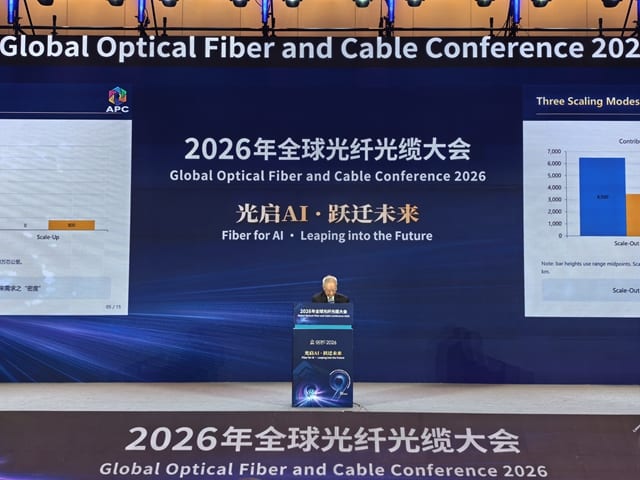
Speaking at the Global Optical Fiber and Cable Conference, Wen Ku said AI, computing power and data centers are reshaping fiber optic cable demand, and urged upstream and downstream players to establish long-term price negotiation mechanisms and expand capacity rationally. He noted that global fiber demand grew 4.1% in 2025, with data communications and data center-related demand up 76%, while expanding optical fiber preform capacity takes two years. Wen Ku warned that high prices could trigger a concentrated release of new capacity, recommending more long-term contracts and navigating price cycles through low-latency, low-loss, high-density technologies and diversified applications.
CAICT's Ao Li on Optical Communications Evolution Driven by AI Computing
Ao Li, vice president of the China Academy of Information and Communications Technology (CAICT), said the optical communications industry is shifting from being driven by traditional telecom to being driven by AI computing, with next-generation communications networks and optical networks evolving in parallel. He noted that 1.6T is at the early commercialization stage globally, hollow-core fiber is already used for low-latency dedicated lines and cross-domain computing interconnects, and multi-core fiber is entering high-density data center cable scenarios. He expects optical circuit switching systems to form an optoelectronic hybrid architecture with electrical switching, while the relevant technology roadmaps continue to develop in parallel.
Omdia: Pre-terminated Fiber Expands into AI Data Centers and Other Infrastructure
An Omdia report notes that pre-terminated fiber solutions are expanding from traditional FTTH scenarios into data centers, edge computing and smart cities. Its data show that cloud business is driving data center capacity growth of 25% per year, and AI development will further increase demand for fast, reliable fiber deployment. Pre-terminated solutions reduce field termination errors through improved connectors and plug-and-play designs, while Clearfield's vertically integrated manufacturing is used to respond to customer needs and reduce dependence on overseas logistics.